Tuesday, April 30, 2019

Avengers: Mickey Mouse Rising


So let's do a math problem.

Let's say you have 12 dogs, but only enough food to feed 8 of them long term. You then go ahead and kill 6 of your dogs so that the remainder of them can eat happily and enjoy a life of plenty. "Perfectly balanced" you say while wiping a bit of mustard off your chin, but unfortunately you don't bother to spay or neuter any of them and immediately throw away the shotgun you used to do the deed.

Approximately how many years would it take to realize that you're a fucking idiot?

I thought about writing a review of Infinity War when it came out, but found that the sheer weight of stupidity at play in that movie was too much for me. I'll attempt it now that I've seen two of the damn things, but I can only do so much.

Still. Let's try to go through the key points.


There's more ...

Saturday, March 30, 2019

Lethal White


So Lethal White, the latest crime thriller by Robert Galbraith aka JK Rowling, is the harrowing tale of the grizzled Detective Comoran Strike and his gorgeous assistant Robin's eternal struggle to come up with more reasons why they shouldn't sleep together even though they both would very much like to.

The Strike books have thus far been on the 'pretty good' side of things, but I am sorry to say that this one only manages to reach the level of 'it was alright I guess'.

One of the reasons for this is that the sexual tension between Strike and Robin is so damn thick so as to be distracting. That has been an ever-present part of these novels since the get-go but it's getting to the point where it's been milked for all it's worth. It's just painfully obvious that that's where that arc is going and having page after page of Robin contemplating whether she loves her boss or not while Strike broods about how he hates the fact Robin is married now is just plain dull after a while.

Another reason for this is that the murder plot at work in this thing is so utterly and ridiculously elaborate that it is just plain cartoonish and needlessly complicated. I mean, it gets to the point where I was ask myself at the end: "Is killing someone like this really less efficient than just leaving a banana peel on the stairs or dropping a toaster in the bath?"

And the fact that witnesses openly withhold critical information from Strike for no damn reason for the bulk of the book and Strike just sort of nods and plays along. There's a blackmail plot and no one wants to say what the damn guy is being blackmailed about. At a certain point, one would have expected our hero to just say: "Look, do you want this shit solved or what?" but that moment just never came.

The thing is still well-written and I like these characters. When another of these things, I'll read it. But the prime emotion I associate with the text is still irritation. Either I was feeling irritated at the two protagonists' love problems or at irritated at the frustrating way that the investigation was artificially handicapped from the get-go.

Lethal White is thus a fairly unremarkable offering, typical of this era of mediocrity that we are currently suffering through.

Anyway, let's talk some book specifics.


There's more ...

Saturday, June 24, 2017

Persona 5


I bought a PS4 just so I could play this and feel it was worth the price of admission.

Persona 5 is a game that achieves a special kind of perfection. It takes the foundations that were laid down in Persona 4 (and Persona Q too) and takes them to a level of perfection beyond what even the most ardent fans were expecting.

Storywise, the game is thematically distinct from Persona 4 in that there is no murder mystery to solve, but rather a larger conspiracy of adults to oppose. P5 is a game whose central theme is outcasts conducting a rebellion against our shitty modern society. The result is our protagonists are much more active this time around, with all of the Phantom Thieves' heists into cognitive dungeons feeling more than just typical RPG romps where you bust down the door and kill everything until the problem is solved. Since you are Phantom Thieves there to steal the hearts of your victims, the game has the 'dungeon' portion consist of sneaking through guards until you've got your entry route, at which point you leave and send a calling card announcing your intention to come for the target. As your guys come together for the final blow, the game gives you all the feeling and satisfaction you might feel when a good plan comes together.

For gameplay, the game has taken all the niggling annoyances of the first game and removed them while enhancing what P4 already did right. Instead of a fairly basic 'see enemy and fight enemy', you've got a (admittedly very simple) stealth system that gives the player an advantage for initiating a battle out of stealth. Instead of the randomly generated dungeons, you've got dungeons that are meticulously designed to give you a perfect feel for what you're doing (with some pretty good puzzles to boot).

Special mention goes out to how they've changed Social Links to make it so that non-combatants give you assorted benefits for maxing them. That gave the acts of getting bonds feel less like pissing away your time between the real stuff and more like being an active revolutionary who is gathering backers and resources for the cause.

Persona 5 oozes style out of every orifice, effortlessly achieving what other RPGs can only wish to have a fraction of. It's worth playing.

Now let's talk about some specifics...


There's more ...

Saturday, December 17, 2016

Star Wars Rogue One - Milking that Cow


So I liked Star Wars: Rogue One, but I sort of don't like the fact that I did.

I can start by saying with certainly that it's better than the Force Awakens. It's pretty clear from watching it that Gareth Edwards gives much more of a shit about being true to the setting than Franchise Necromancer J.J. Abrams ever did. In this film, the X-Wings (fighters) cover Y-Wings (bombers) and no Tie Fighters are arbitrarily given a life support system when one of the named characters steps inside. So that's great. It's nice to see someone giving a fuck about things like that, even if you're going to fuck the continuity in the process (see end of this post).

But still, ultimately this is as much of a cash-in as our last Star Wars outing. Disney's clear intention with these things is to milk the series dry, and it's clear that there's quite a lot of milk to be had. Say what you will about the prequel trilogy (and there is quite a lot to say), but I never got the impression that Mr. Lucas was primarily concerned with making money. In a sad sort of way, it really felt like the stupid hack thought that these were stories that somehow needed to be told. Even though those three movies are utter cinematic vomit, there's a certain earnestness to the movie spinning the line 'this is how democracy dies, with thunderous applause' as if it was some kind of poignant political commentary.

These Disney films though, with all of their fan service and nostalgia injections, have the reek of money about them. It seems that behind (almost) every creative decision is someone saying: "We paid 4 fucking billion dollars for this fucking franchise and we're going to squeeze every fucking dollar out of it." The movies ultimately are doing their earnest best to please, to placate and never to challenge. The creators are just saying to give the viewer their nostalgia trip, along with a few more figurines and bits of merchandise to add to their collection, and then call it a day.

Bringing it back to Rogue One, we get a movie that is essentially "what we want", where 'we' is essentially the adult male ex-Star Wars fan. This is prole-feed that's explicitly directed at people like me, who can tell a Tie Fighter from a Tie Interceptor by their silhouette. and I think that's an important thing to recognize.

In any case, with that now done, let's talk about the film in some detail.

1) Star Wars: Rogue One is a superfluous film. 

The whole thing tells the story of the epic struggle that took place before Episode 4 to get a copy of the Death Star's plans to the Rebel Alliance. But the thing is, we pretty much already know how much of a struggle that was. Take a look:


This is a simple and effective way to tell the viewer a story. Rebel ship - small and scrappy . Imperial ship - big and authoritative. From this one image we can already gleam what happened before the movie begins and just how tough it must have been to get those Death Star plans. An extensive flashback to explain it is thus completely unnecessary and adds nothing to the overall story.

(Huh what do you know, that's just like the other prequels)

Still, this is Star Wars and Star Wars fans love nothing more than going through things in excruciating detail. Previous to Necromancer Abrams resurrecting this dead franchise, there was quite the burgeoning novel industry surrounding it with the whole "Extended Universe" deal, which gave us entire novels and books of short stories dedicated to subjects like the identities and backstories of those other four Bounty Hunters who lined up with Boba Fett in the Empire Strikes Back.  Do we need to know who those guys are? No. Does knowing about it make the original story better? Not at all. But are people going to want to spend money finding out about it anyway? Hell yes.

And that's essentially what this movie is. It's clear now that, even though the first thing Necromancer Abrams did when he got this thing was scrap the Extended Universe's place in the canon, Disney's intention with these Star Wars films is to essentially apply the Extended Universe's logic to the films and just start churning these fuckers out and letting that money flow on in.

So we're going to get a film in 2018 about Han Solo and how he became such a scoundrel and met Chewbacca or whatever. I imagine by 2022 we'll start getting ones about Wedge Antilles, Lando and Mon Mothma.

2) Star Wars: Rogue One is a (relatively) dark film.


Never before have the films tilted in this direction of moral nuance. What I mean by that is that in every other Star Wars film you're going to be a morally upstanding Rebellion/Republic dude, a bad Sith/Empire guy, a Smuggler or some kind of ultimately-irrelevant alien. And I guess you could also be someone in the process of transitioning from one category to other.

In this though you had Saw Gerrera, an insane rebel whose ethics were clearly quite questionable. You also had the rebels conducting daylight raids against Imperial soldiers that are shown to result in civilian casualties. This all is forgotten by the third act, but it's new ground for the Star Wars films certainly.

The big battle at the end is a thrillingly filmed affair, with named characters dying left and right. Normally in Star Wars a named Rebel character is only allowed to die in order to be part of someone else's character development, but here the director clearly went out of his way to apply some grittiness and even perhaps realism to Star Wars.

Going back to my primary thesis though: This is what a segment of Star Wars fans have always wanted. I can name about a dozen video games that put the player in the role of  the 'ordinary Rebel trooper' trying to overcome the odds against the Empire, and there are plenty of stories in those games (and the old EU novels) about Rebels who go too far.

It would thus be incorrect to say that this is a bold new direction for Star Wars. I characterize it more as tapping into an audience that had already been cultivated.

3) There's a weird pro-Jihad vibe in the film. 


So the first shot of the Death Star is at a 'holy city' called Jedha, pronounced 'Jed-ha'. That name is clearly taken from the city of Jedda, which is an ancient city in Arabia. Inside Jedha you also apparently have 'Kyber crystals', with Kyber being pronounced exactly like one says 'Khyber Pass', which is the Afghan/Pakistan border. And to drill the point home, the city and indeed many of the rebels have an Arab/Ottoman motif.

The director of the film apparently said:

"If you believe in the Jedi and you believe in the Force, it feels like Jedha is somewhere you should visit in your lifetime."

... meaning that it's apparently Jedi Mecca or something?

So you've got yourself a holy place that the Director explicitly wants to attach to Islamic holy places. Said holy place is under attack by an outside Empire that massacres the population. The surviving warriors then band together to bring down said Empire and liberate the lands from the invading infidel.

Do you see where there might be uh... certain parallels?

So uhhh... real world analogies and Star Wars usually don't work very well. I think Colbert said it best when he said that every side thinks they're the Rebellion. But the movie's racialization of that group of rebels is making an explicit connection between the Rebel Alliance with Jihadist Radicals and the Empire with Americans.

Now uh I don't necessarily disagree with that last bit, but why the fuck is a profit-hungry Star Wars movie doing that?

If anyone wants to explain it to me then go ahead. My best theory is that this is an inadvertent consequence of the effort to give the Rebellion shades of grey. "Not all Rebels are good, some Rebels can even be ARABS" is perhaps what the Director was saying without fully considering the consequences of that assertion.

Though of course the other possibility that Gareth Edwards has secretly given his bayat to Baghdadi.

I report you decide.

4) I felt more for the humanity of the Storm Troopers in this than I ever did in Force Awakens. 


How many of these fuckers die just trying to ask people for their papers? It's not their job to set the rules about ID card protocol, you know. And shouldn't spies carry forged documents before they infiltrate enemy cities? What kind of spy doesn't have that?

Just once I'd like to see this:

Storm Trooper: Hey, let's see some identification.
Person: Here you are.
Storm Trooper: Thanks for your cooperation.
Person: Have a good day.
Storm Trooper: Stay safe.

5) The ending scene with Vader shits all over continuity. 


Let's just look at it:

Princess Leia Organa: Darth Vader. Only you could be so bold. The Imperial Senate will not sit still for this. When they hear you've attacked a diplomatic...
Darth Vader: Don't act so surprised, Your Highness. You weren't on any mercy mission this time. Several transmissions were beamed to this ship by rebel spies. I want to know what happened to the plans they sent you.
Princess Leia Organa: I don't know what you're talking about. I am a member of the Imperial Senate on a diplomatic mission to Alderaan...
Darth Vader: You are part of the Rebel Alliance and a traitor! Take her away!

#1 - If her Correlean Corvette was literally launched as an escape pod out of a fleet battle with the Imperial fleet with a floppy disc as Vader watched, then he should not be saying 'several transmissions were beamed to this ship'. He should be saying 'I saw that asshole with the floppy disc get on this ship, where is it now?'
#2  - Leia's cover mission also makes no sense. You were on a diplomatic mission to Alderaan? Really? After they literally just saw this ship escaping a giant fleet confrontation?

But well I guess you'd have to be a nerd to care about shit like that. 
There's more ...

Sunday, July 31, 2016

Harry Potter and the Cursed Child


So this takes me back.

(I last blogged about Cursed Child a few months back when the decision to cast Hermione as a black lady was announced. Let me quickly address that: My objection to that was that no script was being released and switching mediums like this was breaking my mental image of who Hermione was because there was no script being released and so the play was the only authoritative version being presented. A week after I wrote that up, it was announced that the script was actually being released, and so I ended up with egg on my face. But oh well, that closed off that discussion as far as I'm concerned.)

Anyway, let's talk about this then. First without spoilers:

1) The plot and characters are good.

I actually came into this prepared to not like it. Expectations are high for an 8th Harry Potter book and one never knows what an author is going to produce after taking a break from a text for a good decade. But it is a perfectly good Harry Potter text that is a completely valid entry into the canon. It skirts the edges at times, often getting its plot tied into knots with unexpected twists leading to more and more twists. And the fan service element does get a bit extreme after a time and there are moments when Harry's son Albus is irritating and whiny. But while it touches those edges, it doesn't jump right off.

Again, it's good. Often, it's even great. So no worries there.

2) The play would really be better off as a novel.

That's for a pretty basic reason... When new characters step onto the stage, how was I supposed to know what they were supposed to look like? At first I thought that it'd be a good idea to just google image search so I could see what the actor/actress they had cast for that part. But that of course resulted in a plot point being spoiled for me. Fuck.

So you know... a simple cursory description of what a character might look like could have been good, you know?

3) The play really reads more like a movie script.

It's got a frickin' montage for crying out loud. What play has a montage? Do you know how hard it would be to do a montage on stage? Reading through it, I have to say that I think this is probably the most high-budget and staggeringly expensive/difficult to produce plays in human history. I can get how you can do certain parts, but the amount of back-and-forth scene switching, special effects and pyrotechnics this thing would require... well, it'd be staggering.

I'm sure they're managing that over in London of course. If there's ever been a play with a bottomless budget, it's this one. But you won't be seeing productions of this at the local community theatre.

I feel that it's inevitable that this thing is going to be a movie (perhaps even two movies). I'd give it two or three years perhaps. I honestly can't help but feel that it being a play is some sort of grandiose gesture on JK Rowling's part. Her way of trying to breathe some life into an increasingly niche medium perhaps? And you know, that strikes me as a tad bourgeoisie.  As Jim Hacker once argued, the reason the common man in the streets isn't going to see plays is because they're inaccessible and bloody expensive. Charging 500+ dollars per seat isn't going to do much to change that.

But well, we can't really change that sort of decision, can we? So for now I'll just say I look forward to the movie version.

Anyhow, let's proceed now with the nitty-gritty.

Spoilers ahead!

While I did enjoy it, I do feel that the 8th Harry Potter story is the weakest entry of the eight Harry Potter stories.

Let's talk about why that is.

1) Time Turners.

Patrick Rothfuss once remarked that the problem with introducing Time Turners into a fictional world was that one would have to examine the consequences of their existence beyond Hermione being able to take some extra classes. And you know, Mr. Rothfuss sort of has Rowling there. If you can travel back in time reliably, then why don't you do that? Why didn't someone just hit the Time Turner the moment Snape killed Dumbledore or what have you? And if there are big anti-time travel laws in place by the Ministry, why the hell did they make an exception for a 14 year old girl?

I always had Time Turners down as a Prisoner of Azkaban-only gimmick. Something cute for that book only that you weren't meant to think about too much. So it was much to my surprise to find them featuring centrally in Cursed Child. And let's be honest here: Time Turners cause way too many plot holes.

Let's take a point from the end. There's the whole thing with Albus and Scorpius being stuck in the past while Harry and company have a Time Turner but don't know what date to point it to. Everyone's tense and trying to figure something out, until we get the nice sentimental moment where Harry finds the secret message from Albus on Lily's pillow... the whole audience is in tears as the message from son to father carries through the legacy of a dead mother, until one stray thought comes into your mind...

Why don't they go back in time to the hour before Albus and Scorpius broke into the Ministry to steal the first Time Turner and beat the everloving shit out of both the goddamn brats?

Yep. I know. It stings.

Look, I get it. I've seen those episodes of Star Trek too and know you're just supposed to ignore that kind of reasoning. But Time Turners are more than just a gimmick to save the day in this story, as they were in Prisoner of Azkaban. You didn't need to care about Time Turners in PoA until after the great scenes with Sirius were already done. But in this, well... the spotlight is on these things throughout. And when you have such a damn silly thing driving your plot, you're bound to hit that wall.

2) Ass pulling.

There are two elements in the ending that felt both rushed and awkward.

First, you've got the aforementioned mommy's blanket with its secret message. If a tincture of demiguise reacts with a love potion, it will burn. Burn in such a way as to not start a fire, but rather form perfectly neat letters. And some of said tincture just so happens to be in the house over here. Also the demiguise will keep for forty years and Harry will never think to wash the blanket or accidentally spill mustard all over it.

Harry Potter is a series with literal magic solutions to everything, but with the umpteen million ways that you can send secret messages in this world, THAT is what Rowling came up with? Come on, Ms. Rowling, you can watch better Star Trek episodes than that.

Second, there's Draco's second Time Turner.

We now know that Lucius Malfoy had a perfect time travel device in his back pocket. So when Dobby was freed, he could have just gone back in time and... no wait, let's not go down that road again.

What we do know now is that Draco apparently had a game changing magical item in his possession that he chose to simply leave in a trunk somewhere until the most dramatically appropriate moment. If there were at least a hint that Draco had one of those before that moment, I would be alright with it. But there wasn't. The plot required him to have it at that moment and so he had it.

3) Delphi.

It's strange that the most fascinating thing about the play is also the aspect I found to be most disappointing.

The daughter of Voldemort plays a really cool role in the first two thirds of the play. A manipulator/instigator who never gets her hands dirty... she's presented as a love interest for Albus, or even as the Hermione to Albus and Severus' Harry and Ron. But she came across as being perfectly likable and her mysteriously being kept away from Hogwarts gave her a certain foreign and intense quality.

And so when at the end she just started flying around being evil, I couldn't help but feel let down. The fact that she is presented as acting out of a weird form of love for her absent father is not really well examined and as she gets beaten up and sent off to Azkaban, her potential feel thoroughly squandered.

As a villain, her biggest play is trying to bring back the last big bad, an action that thoroughly consigns her to a tier 2 position. As a character, her arc seems to just sort of sputter out at the end there as the good characters beat her down. Albus' attraction to her gets laughed off and that's that. Maybe JKR will make another of these things and she'll come back for a second go at it, but as it stands Delphi leaves the play looking like a weak character that tried to resurrect a dead idea and got the shit kicked out of her for doing it.

Now, does all this mean that the play was bad? By all means no. It had faults certainly, but I enjoyed reading it and reflecting upon it. But ultimately, the play does not measure up to the first seven books.

There's more ...

Tuesday, December 22, 2015

Star Wars: Episode 7: The Force Awakens

I don't even know if I should bother writing about this, but well... may as well I guess?


Star Wars: Episode 7: the Force Awakens has the distinction of being better than 50% of the previous films. And while it deserves a hearty congratulations for having achieved that much, I do think that it needed to be a bit better than that.

Don't get me wrong. It's a passable film. The action clips along at an acceptable pace, the characters are distinct enough for me to remember most of their names and there wasn't anything offensively bad about it. But that's about it. It gets a passing grade, but nothing beyond that. Honestly, I don't think I'll remember anything beyond the major plot points one week from today.

So before I inevitably forget about this thing, let's talk about it.

The perspective I'm writing from is that of a former fan. In my middle school years, I was all about Star Wars and I read every single Extended Universe book I could get my hands on, even the ones by Kevin J. Anderson. That enthusiasm was beaten to the ground by the Prequels. I liked Knights of the Old Republic 1, but generally speaking I haven't cared about Star Wars in some time, even though I still happen to know a fuckload of stuff about that universe.

So why didn't this movie win me back into the fold? Let's see...

Spoilers ahead, I guess.

1) Shoddy writing.

I think this is the first JJ Abrams product I've actually watched so I can't really compare this to his other works, but I had trouble swallowing the motivations and actions of some of the characters. I'm going to focus mainly on the Storm Trooper deserter, Finn.


Finn here deserts the First Order because he realizes that the Empire is cartoonishly evil and decides that Killing Is Wrong. In order to escape from the Empire, he proceeds to shoot up a hangar bay full of his former comrades, seemingly killing about 30 or 40. So errr... this individual in the military got upset about the direction his government was taking and decided to go ahead and murder a bunch of his colleagues. So... does that mean our main protagonist is basically the Empire's equivalent to the Fort Hood Shooter then?

 This wouldn't be so bad if the issue were raised or acknowledged somehow, but it's not. Bad guys called Finn a traitor later on, but he is all too happy to just go ahead and shoot or stab them. Never once is the idea that one of these other Storm Troopers might also be closet dissenters or other people who were conscripted away from their families at a young age just like he was. Finn just kills them.

Why make him a Storm Trooper in the first place if these issues weren't going to be dealt with? Why give him that back story if it wasn't going to affect his character development at all? I think this Abrams guy just liked the visual of the Storm Trooper deserter, but really just did not adequately think it through.

2) Shoddy dialogue.


If I were to describe the dialogue in this film it would probably be something along the lines of "Badly Written Joss Whedon". Everyone is trying to be snappy and clever, but no one is saying anything worth remembering. While sometimes a line hit home ("That's not how the Force works"), the movie is filled with awkward garbage lines about boyfriends and fixing compressors.


At one point in the film, Finn is watching an X-Wing blowing up TIE Fighters from the ground (ignoring the fight all around him) and gasps: "Wow, what a great pilot!" on behalf of the audience. The fact that the guy is blowing away six TIEs in 5 seconds already is showing that, but I guess Captain Obvious needed to make sure the audience was making the right conclusions here.

3) Not giving a fuck.

There are certain details about this universe that I could tell you, even though I haven't really thought about it for a solid decade.


For instance, there's a scene where Finn and the pilot guy escape in a TIE fighter. While in said TIE, they don't wear space helmets and are able to breathe. But TIE Fighters aren't supposed to have life support. That's why their pilots wear those bulky black outfits. Because they'd suffocate without them.

"Well maybe they got air after twenty years," you say. Except that the other TIE pilots we see in the movie are still wearing the black fighter outfit that they were wearing in the original films. Why are they still in bulky space helmets with very distinct oxygen tubes if they've got atmosphere inside of their fighters? Wouldn't they wear the grey uniforms, like their colleagues on the Star Destroyers? Why give them atmosphere in the fighter if they aren't going to use it? And no, if it were a special TIE then they should have fucking said it was a special TIE. Or just hijacked a shuttle instead. Shuttles have air.

You may think this is quibbling and nitpicking, but this is the thing: Getting this shit right is a sign of love and care for the setting. It's a sign of attention being paid to detail. If Abrams can't give enough of a shit about the Star Wars universe to offer an explanation as to why that TIE fighter had life support, then why should I give a shit about the Star Wars universe either?

So the conclusion:

What this movie is is a cash-in sequel designed to rake as much money out of its name as possible.

Does that mean it was a bad movie? No. Again, it's passable. But I nevertheless left the movie feeling quite thankful that I've stayed well-clear of whatever the hell this man did to Star Trek.
There's more ...

Monday, December 21, 2015

Harry Potter, Medium Swapping and Continuity

So this is sort of bothering me, and so I will sound off on it here.

Today Harry Potter and the Cursed Child had its cast announced. Here they are:


So beyond the Ron with hair that is distinctly not red, you've got yourself a black Hermione who apparently did not magically fix her teeth in her teen years.  My first reaction to this was a definitive: "Huh?" This bothered me a lot more than I thought it would and, after much reflection, I think I've determined the reason why: The stage is a visual medium and JK Rowling is slapping her fan base in the face by insisting on making her sequel on it.

Stick with me and I'll take you through my reasoning. 

First, let me talk about why I think this matters.

For an established character, the image and feel of a character counts. For instance: Jean-Luc Picard is bald. If (God forbid) a 'sequel to the Next Generation' series were pitched featuring Picard with a full head of hair, then I would feel quite justified in screaming bloody murder. Once a character is established to look a certain way in a certain continuity, then you've gotta stick with it. If you put Fabio in Picard's shoes then I don't feel comfortable or respected as a fan in the setting.

Now the question of race and superheroes has been popular in the media lately. I hear a lot about the idea of a black James Bond or Spider Man for instance. And you know, I'm not against either idea. Just make them in their own continuity. I mean, fuck, you're resetting Spider Man every two fucking movies anyhow, so why not give it a try? And hell, don't those kinds of movies shift continuity every time they change their lead actor anyhow? 

But in any case, the point I'm trying to make here is this: I would not care about this issue if the above Hermione were in an alternate universe adaptation of Harry Potter. The distinction I draw is that this is a Hermione who's supposed to be in a direct sequel to the books.

Anyhow, so now let's get the author's position:


This makes sense to me. I actually avoid racial descriptors when I describe a characters too, which I've observed has resulted in arguments in what people think a given character actually looks like. I think some degree of ambiguity in that regard is sort of necessary, particularly in a book where we're expected to relate to and invest in certain characters. I get that.

For me it goes like this though: I open Chamber of Secrets and read: "Hermione snatched the timetable back, flushing intensely." (75) All human beings have the blushing reaction, but for what should be obvious reasons it's not very distinctive on a person with some colour on their face already. You can't tell when a dark skinned person is blushing as easily as you can a pale person. Hence why I always pictured the gal as being white.


"But that's just your perspective and it's subjective," I hear you say. And well yeah, of course it is. The Hermione in my head is indeed a white girl, but if she's black in yours then that's your prerogative. I don't think it would effect our mutual enjoyments of the books.

But that's the thing, isn't it? This isn't a book. It's a play. A horrendously expensive and inaccessible play that a pauper like me can never hope to see on stage, but nevertheless: a visual medium. We aren't in the Theatre of the Mind any more, we're in real space. The "you can picture whatever Hermione you want" argument breaks down because for this play, which is billed as a sequel to the Harry Potter books,  there is now just one Hermione. The one on stage. And the lady they're putting on stage looks absolutely nothing like the Hermione I've imagined.

"Wait a second," I hear you say, "Why should your white Hermione take precedence over my black one?" And you're right, I can't give you an objective reason why that should be. But note: the argument works both ways. Before everyone would read the books and make their own world. When the movies came out, mileage varied. Many people (including me) thought Emma Watson was a bit too pretty to be Hermione for instance. And for me, Kingsley is always going to be a Samuel L. Jackson type figure. But nevertheless: Previously, what was a point of contention like that could always be resolved with the words 'but well, in the books we can make our own sense of it'.

But now there is no book. There's just a play. (And hopefully a script that they'll eventually publish for us poor commoners)

And that brings me to a fundamental conclusion about all of this: Making the sequel to a fabulous series of books into a London-only stage production is a huge disservice to the fans. It's whimsical on the part of the author, it's anti-democratic and it flies in the face of the magic that the Harry Potter books really allowed the reader to do within its pages.

JK Rowling can do whatever she wants, of course. But you can't do a medium swap like this and not expect to irk people like me.
There's more ...

Thursday, November 5, 2015

Career of Evil


JK Rowling's "Comoran Strike" series doesn't really get as much attention as it deserves.

Part of this is probably because there's no magic, dragons or Hermione in them. Another reason is probably because it's in a niche genre that not many people pay much attention to (gritty crime fiction set in London). And the fact that the crimes so far have generally focused on the fucked up crimes of a bunch of grotesque perverts probably doesn't help things.

And you know, I get that to some extent. The sense of wonder that the Harry Potter books fostered is not something that these books, by their very design, will ever be able to reproduce. That turns a lot of people off and I can thus understand why these things aren't flying off the shelves the way Potter did.

But still, that doesn't change the fact that the Strike books represent some of JKR's strongest writings to date. Career of Evil in particular is extremely well plotted, with a character arc seamlessly integrated into a three-pronged mystery that unfolds beautifully. It's gruesome, particularly the short chapters told from the murderer's perspective, but it all still ties together spectacularly.

So let's go ahead and discuss Career of Evil and its primary features. Spoilers ahead.

1) Robin x Strike

 Robin probably has the biggest role in this book so far. The partnership with Strike is cemented at this point, as is her taking an active role in the investigative parts of the business. The relationship between Strike and Robin has been carefully and artfully plotted out in ways that the Harry Potter romances (fuck off Ginny) never were.There's a steady and gradual shift in emotions between the two of them that drifts towards a romance, but never seems to make it there.

Rowling here I feel is showing how she's completely in command of her audience. As readers, we're made to very badly want Strike/Robin to happen. But the unwavering reality of the situation is that them getting together would be a tad ridiculous. You can't imagine a functioning detective agency where the lead detective is dating his partner.

By keeping them on that razor line between professionalism and following their hearts makes the relationship develop slowly but surely, with self-denial on both sides. They clearly have feelings for one another, but they can't act on said feelings for some very solid and realistic reasons. The blindness Robin shows when she goes back to Matthew (fuck off Matthew) is that much more frustrating for the reader because we know that.

I don't think Strike will so much as kiss Robin until Book 6 or 7, but the inevitable pay off will be incredibly sweet. The readers are made to be hungry for it and by the time it happens it'll be a breath of fresh air. That's really just brilliant writing and Rowling deserves to be commended for it.

Now if only she'd done as good a job with relationships back during the Potter days...

2) JK Rowling knows how to keep a mystery going.

Career is great because the three primary suspects are laid out before us right from the get-go and builds a case against all of them in equal measure without giving matters away. She even gives us those murderer-perspective chapters and somehow manages to not give away the game.

From the get-go, I wasn't thinking Brockbank could be it. I mean, the guy is a pedophile and there was no mention of the murderer guy taking a moment to molest a little girl in his murderer chapters. I went back and forth between Laing and Whittaker for most of the novel, mainly leaning towards Whittaker until Robin got herself knifed.

I completely did not see the Fireman thing coming. It seems obvious in retrospect, but of course all of JKR's books have that quality.

Well played, Ms. Rowling.

3) JK Rowling really likes exploring grotesque and dark stuff.

All three of the suspects in this series are loathsome misogynistic perverts that deserve to be put down. A child molester, a wife beater and a... however the fuck a person would describe Whittaker. This paints a picture of a world filled with horrific people lurking in the shadows waiting for the opportunity to knife someone for some scarcely understandable reason. It certainly doesn't make me want to visit London any time soon.

Nevertheless, we do seem to see in JKR a woman who doesn't seem to have an overwhelming amount of faith in humanity. In the HP books, the majority of Wizards end up kowtowing to the Voldemort-controlled ministry. It boils down to a handful of good people having to fix everything. In the Casual Vacancy, meanwhile, you had no good people whatsoever. Just assholes and their victims.

In Strike's world, it really seems like everyone but Robin and Strike are living in blissful ignorance and that the police are proud fools. The average human being, at least in Rowling's telling, really is a bit of an incompetent and selfish jackass.

And you know, I find that kind of interesting.


Anyhow! Overall impression: Superb book. Looking forward to the next one, Ms. Rowling.

There's more ...

Tuesday, August 4, 2015

Persona Q - Shadow of the Labyrinth


 So Persona Q is a crossover game that involves the Persona 3 and Persona 4 casts meeting up with each other in a strange nether dimension (filled with labyrinths). I bought this back in December, expecting just a fan servicey non-story that would be good for a couple of hours of smiles and inside jokes before everyone packed up and went home.

What I did not expect from the thing was a story driven 73 hour RPG epic that would take me about 6 months to get through. From beginning to end, Persona Q surprised me. It surprised me with the surprisingly depth of character customization. It surprised me with its simple but compelling story. It even surprised me with how much character development the cast got. And even after having beat it, I'm still surprised that this thing exists.


Which I guess is a fancy way of saying that I thought PQ was in fact quite good (with some caveats).

Let's talk about why that might be...

1) Character exploration.


At the beginning of the game, you get to pick whether you want the story to focus on the Persona 3 side or the Persona 4 side of things. I've played both games, but needless to say I picked P4 because its cast is vastly superior. For those curious, if you've only played P4 then I don't think that'll really affect your enjoyment of the game. Prior knowledge of who the P3 people are is not required.

At first, it was what I expected from the game... Chie talked about how much she likes meat, Yukiko did her stupid laugh, Kanji talked about manliness and all that stuff. But as things progressed, I was surprised to see that the game actually meant to set out to explore the personalities and relationships of each of the characters.  I got to flirt with my long standing girlfriend Rise and even have a funny/surprisingly heart-jolting fantasy wedding with her.

But the primary beneficiary of this is none other than...


Naoto joined late in P4 and thus didn't get to shine as much as everyone else as a consequence.  I was thus really happy to see that she's basically your chief adviser here. Throughout the game, her insecurities about her gender identity are discussed and why it is she felt the need to pose as a man. The character of Naoto is often criticized by the SJW games media for not rejecting gender reassignment therapy and even would go on dates with men. People that make that criticism fail to realize that the reason she was putting on that act at all wasn't because of discomfort with her physical body, but rather a feeling that she couldn't do what she wanted to do as a woman. That her gender handicapped her ability to pursue her dreams.

Anyhow, in PQ we start to see her come to terms with that and she starts to decide that maybe she can be who she wants to be in spite of her gender. Those scenes were great to read and really enhanced this most unique character.

The game also ships Naoto and Kanji as a couple really bloody hard. I thought it would be more neutral, but for a fair chunk of the story they seemed like two steps from just running into an empty classroom and having their ways with one another. Though I won't complain, I've always really liked that couple.


I especially liked their battle quotes to each other. "Kanji-kun! Are you alright?" "Yeah... why? Worried?"

2) Gameplay.

This game is sort of insane in that you have 19 playable characters (10 from Persona 3, 8 from Persona 4 and 1 new guy), all with unique equipment load outs and skills that you can customize with Sub Personas that give health and SP bonuses. They've also made it so certain characters are ranged while others are melee, just to make things more complicated. While you can only have five people in your party at once, the game encourages you to swap between them by making healing cost an arm and a leg (at least for the first few dungeons) and having certain subquests require the presence of specific characters.

This thus ain't no casual affair. The dungeons are as brutal as they always are and having a well balanced team is key to success. And you know what? I like that. Hook me in with great characters and then challenge me with brutal fights. More games need to give the player more credit where credit is due.

Word to the wise though...


Naoto is pretty overpowered. Give her a Sub Persona that gives her a big mana boost and start every fight with those Light/Dark insta-kill AoE spells (Mahamoan and Mamudoon I think they're called). For a large number of random encounters, Naoto can pretty much kill everyone by herself in one spell.

I think one of the devs really likes Naoto.

3) Puzzles.


The weakest element of the game is probably in its puzzles. They aren't overwhelming most of the time, but they are really complicated. If you're like me and usually only use your 3DS when you're in the bus or suffering from insomnia, then you're going to find that remembering what the puzzle you were doing after taking a break for a day or so is pretty disorienting. This is only made worse by the fact that you can still be slammed with random encounters while trying to figure something out.


To make matters worse, most of the puzzles in the game involve super monsters called 'FOEs'. These are generally boss monsters that are easily strong enough to wipe your party out if you don't run away. Generally speaking, you're supposed to just avoid walking into one and you're fine, but unfortunately the puzzles are all of the 'do this wrong and you an FOE will take you anally' variety.

That said, if an area really gives you trouble you can man up and jump the FOE intentionally to try to kill it and simplify matters. But given that they are incredibly powerful, this will only get you so far.

On one hand, I again appreciate that the game respects me enough to make things this hard, but I'd be lying if I said that some of the puzzles didn't get on my nerves after a while.

There was one interesting occasion where I was presented with a puzzle so obscure and so complicated that I had absolutely no idea how to go about solving it when, much to my surprise, Naoto figured it out and told me exactly what to do, step-by-step


I've gotta wonder... did it happen that way because the devs looked at the puzzle afterwards and realized that no one could ever solve it or did they design it that way to just show us once again how much they love Naoto?

Either option is possible!

All in all: If you're like me and are probably going to get a PS4 when Persona 5 comes out (please give us a sub option, Atlus ;_;) then this is a game you may enjoy. Go get it.
There's more ...

Friday, December 19, 2014

Metal Gear Solid V: Ground Zeroes


So my infamous review of Metal Gear Solid 3: Snake Eater is perhaps one of the most glorious things I've ever written. I've shown it to quite a few MGS fans over the years and the reaction usually is something like "I CAN'T READ THIS" or "I am not even going to TOUCH THIS". It is MGS fan kryptonite, a review so scathing that cuts so deeply that they know that, were they to truly look at it with a truthful eye, they would have to renounce their affection for the series. 

It comes as little surprise then that a long-time fan bought me a copy of the new 'Metal Gear Solid: Ground Zeroes' game that's recently seen release on Steam. So I've gone ahead and played that... all 2 hours of it... and am now ready to draw my sword against my old adversary once again.

Don't get me wrong:
The game works well and is a perfectly functional port. And the gameplay is adequate, even if the game is a criminally short two hours. The controls are tight (I used a PS2 controller for it and my only complaint is that I don't like aiming with the right control stick) and the guard's AI is interesting but flawed enough to give you lots of room for error.

But the problem, of course, is that Hideo Kojima wrote it. So let us discuss that at some length.


1) Kojima has no idea what kind of story he wants to write.

There are certain writers who give away their interests when they write. We know, for instance, that over at the Bioware writing desks they spend their lunch hours and break times playing 40k. In just the same way, we know from Metal Gear Solid that Hideo Kojima spends his spare time surfing the history section on wikipedia, reading conspiracy theories and watching ecchi anime.

I just wish he'd decide which one he wants to do.

He'll try to tie his game to real world events. mentioning things like the Sandinistas and Iran-Contra, and then will make his main villain a guy like this:


And then, before you can get your head around what kind of monumentally idiotic person would come up with something like that, suddenly you start hearing a long monologue about a teenaged girl being molested by a female doctor:


The tone in the average Metal Gear game bounces back and forth from gritty historical realism to loony GI Joe bad dudes to ecchi bullshit so quickly that I genuinely think that Kojima does not know how to differentiate between these three things. To him, those are the three things he thinks are COOL and so obviously he'd put them all into his personal wankfest game. The fact that they don't mesh well at all doesn't even occur to this guy because he lives in an impenetrable bubble forged by his own slavishly devoted fandom.


Ich. Fuck you Hideo Kojima.

2) Kojima is not original.

There are a bunch of tapes you have in your inventory at the start of the game that let you hear about a character called Paz. The above mentioned lesbian molestation is from said tapes. In a subsequent tape, you are treated to a description of what happened to Paz when she caught a cold.

First a dude tries to take his pants off in front of her for some reason and she hits him with a pillow. Then the lesbian lady comes in saying:


And she throws her Kleenix box at her. Then the rest of the cast comes in and there are similar WACKY HIJINKS, until at last Snake himself arrives and she gets all blushy and serious...


This scene is in every harem anime ever made. "Dumb love interests try dumb things in wacky montage, snubs all around, then the real deal happens and mushy music plays." Kojima uses this tripe without a moment's regret.

The basic template for Paz, the tsundere, is employed in similar fashion. In this artless and blunt way, with no drop of humanity or soul in there. Kojima's just saying "I'll do this thing I saw in that anime I watched last night that I liked."

Ugh. And yet this man is lauded as an artist! Fuck you Hideo Kojima.

3) This thing is collapsing under its own weight.

For obvious reasons, this is the first Hideo Kojima game I've played since MGS3. In spite of all the summary pages that the game provides trying to bring me up to speed on a guy called Zero and an organization called Cipher, it still is a huge mess of conspiracies and counterconspiracies, with the KGB and CIA involved in some convoluted plan to do something or other for reasons that are quite obscure to me and that doubtlessly would be obscure to all but the most devoted follower of Kojima.

But Kojima isn't willing to let one thread of it go. It's all shovelled out there and you'll hear these melodramatic dialogues with a guy demanding to know "WHERE IS ZERO?" when you're still trying to remember who the fuck Zero is supposed to be.

This is ultimately why Metal Gear Revengeance (the best entry in this dreadful series, which not by coincidence is also the entry Kojima had almost nothing to do with) succeeds where Kojima's work fails. MGR just said 'yeah whatever' to the history of Metal Gear and focused on telling a story. There was no attempt to weave these crippled details together that you'd have to go back to the old 2D Metal Gears to fully understand.

But Kojima, with his charmed life, cannot understand that and simply assumes that his readers will follow along with him. In the world he lives in, which is so completely insulated from legitimate criticism, such thoughts would obviously be forbidden.

And that is why I'll say it again: Fuck you Hideo Kojima.

I think I'll conclude the matter there, as that's about all one can really say about a criminally short two hour hackjob.

Maybe we'll talk about this again when Phantom Pain comes out, assuming someone gets it for me.
There's more ...

Tuesday, December 16, 2014

Dragon Age: Inquisition


Dragon Age: Origins is a game I quite loved.

I loved the branching paths. I loved the mythology of the world, with the Maker, the Chantry and the Fade. I loved the characters. I loved the combat system. It was a game that spanned a good 80 hours of playtime in a single run through, but which still left me with more than a few unforgettable moments.

Dragon Age 2 meanwhile was a bit of a dip from there.

The world at large is unkinder to DA2 than I am. Yes the fact that Bioware shamelessly recycled old maps was somewhat sour, but it had characters like Merril who I could love and I enjoyed the character-focused narrative.

Dragon Age: Inquisition meanwhile is... well, there's no kind way to say it... it's kind of bad.

It's not terrible by most measures. The game's plot certainly clips along at a decent pace and it's still got all of the mythology from earlier entries that I really enjoyed. But the soul of the series has been drained out. There's none of the humour or sense of wonder that punctuated the original (and, to a lesser extent, its sequel). It's a sort of husk of a game that brings memories of better times, but doesn't have much to offer of its own.

So let's talk about why that might be in my normal fashion.

1) Romance.

So romance is probably the thing Bioware games are most known for. No matter who I talk to about Dragon Age or Mass Effect, the first question isn't "Who did you side with at the Landsmeet" or "Did you save the Council" or "Did you use blood magic to save the Arl?" No, the question is always: "Who did your character shack up with." Outside of the JRPG scene, Bioware is the only company that actually puts romance forward as an important aspect of their games.

Which is why it's mind boggling how bad the romances are in DAI.

As a straight male, you've got two romance options. One is Cassandra, a tough all-business woman who secretly reads Fifty Shades of Grey, and Josephina, a lady who is just kind of there. Both these romances are complete and utter chores to complete. To get Cassandra to like me, I had to roam the world and kill five dudes. She never said thank you for killing these five dudes, or even really extrapolate on why said dudes were all that bad in the first place. I just got a 'Cassandra approves' message, followed by a 'would you like to initiate a romance?' dialogue with her afterward.

The dialogue for the romances is so wooden. Just listen to this. I was absolutely cringing hearing my Inquisitor speak those lines. The fact that this is coming from a company renowned for its storytelling is just mind-numbing.

Back in Dragon Age: Origins, I recall sitting alongside Lelianna by the campfire and listening to her stories of the world. I vividly remember her hauntingly beautiful song of the Dalish Elves. I felt how my character Arathen, an Elf of the Circle of Magi who never knew his own people, would be entranced by her voice and the stories she told. The game made the conscious effort to make me, as the roleplayer, fall in love with this character.

In DA:I no such effort is made. It's just assumed that you as the player will pick one of these people. At no point will Cassandra or Josephina do anything to make you care about them. It's simply assumed by the game that you'll care about them, because it's a Bioware game.

2) Gender and sexual orientation.

As far as I'm concerned, Dragon Age 2 solved the question of the inclusion of homosexual dating options in DA2. They took the simple but elegant step of simply making all four of the romance options (two girls/two guys) bisexual. Bing bang boom, solved. That's less work for everyone involved, particularly if you have the romance dialogue avoid gender specific pronouns. So really, it's an elegant solution for everyone involved.

"But wait," someone at a Bioware board meeting said, "If everyone's bisexual and sexual orientation doesn't matter, then how will we make a character defined entirely by his sexuality?"

In a sensible board room, the answer would've been: "We don't."

In Inquisition's board room, however, the answer was: "Oh good point!"

And so it is that the game has Dorian. Named no doubt after Oscar Wilde's famous novel, Dorian is a character defined entirely by the fact that he likes getting it up the butt. Pursuing this guy's questline literally puts you into a 90s "Dad, why can't you accept me as ME?" after school special. All of his backstory involves his previous romantic involvements. And the game delivers all of this in this smug 'we're sending a social message' tone that you just want to strangle the guy and the developers. 

What saddens me is that this really passes for progress in some circles. As if having a fictional character parrot some cheap talking points somehow changes society. No guys, that's not how it works. Didactic works of fiction never go anywhere. Dorian being a guy defined by where he puts his dick does not make for a compelling or memorable character, unless you're the kind of person who's just that desperate to have a person from that group in your book. In that case, whoopdefuckingdo for your low fucking standards.

But let me just say: DA1 and 2, which both had homosexual options and quite pointedly didn't make a big deal out of it, were much more compelling cases for the normalization of homosexual relations than this utterly backward Dorian shit.

3) Gameplay.

I keep hearing people saying this game is somehow like Skyrim, which makes me wonder if any of these people have played Skyrim before.

Skyrim is meant to simulate an organic world that the player is one small part of. It occasionally has glaring flaws (like villagers trying to fist fight Dragons) but that's the whole idea.

Dragon Age: Inquistion, meanwhile, is a single player MMO. It's about walking around in a big field, finding a cluster of dudes standing around in the field who you promptly murder because they showed up as 'red' on your radar screen. Like any MMO, most of the time the dudes appear to be minding their own business and not doing anyone any harm until you show up and start shooting lightning at them. Are they really in fact 'bandits' in that case? Maybe they just wanted to be left alone? We'll never know.

In any case, the MMO represents the most stagnant and boring genre of them all, one that is sustained only by the happenstance social presence of some other actual humans to talk to. In this case, you don't even have that.

I don't understand why this might be. The original Dragon Age was a strategic game. I recall having Alaistar tank up a horde of Darkspawn, while Lelianna snuck around and Sten hewed them down, all while I engaged in a magical duel with the enemy caster and healed. It was intense, it was fun and it rewarded good planning and effective use of resources. In this, you just click and spam skills MMO style. Why? Why would they do this?

I have one suspicion, which is that they originally wanted to make this an MMO and then, after the Old Republic utterly failed, realized that that was a shit idea. But that just makes it worse if you think about it. It means that they've essentially sold us their garbage.

4) Utter laziness.

I'm just going to list off things in the game that Bioware could've fixed if they could've been arsed:
- They took out the old kill animations. No more jumping on dragon's backs to do cinematic finishing moves.
- There are still only 12 hair styles to choose from, 3 of which are variants on being bald.
- Bioware doesn't know how brown people look and thus makes its brown players choose between being grey-brown and black.
- Their save loading feature forgets half your decisions. Zevran appears in the game through one letter sent to Lelianna. Would it have killed them to make it so I could've used their site to define that or was it just crucial that I read that letter?
- The AI settings are so limited that you don't even have to ever touch them.
- Tactical mode does not zoom out enough.
- The music sucks and hardly plays at all, with the game showing a strong preference for ambient wilderness sounds over any kind of music. This coming from a company that made the Darkspawn theme a couple of years ago, one of the most memorable tunes of the aughts.  Bioware has apparently forgotten the evocative power of music.

And that's just for starters

5) Stealing from Gamesworkshop.

Unity Plaza's inaugural post was about how Bioware likes to rip shit off. I like the universe of Dragon Age, but I remember once that the Penny Arcade guy pointed out that it's ripped off from some other fantasy novel that I don't know, so maybe I shouldn't give them so much credit for it. Still, normal Bioware plagiarism aside, I think it's a good universe.

I just don't know why Bioware keeps going to fucking Warhammer 40k for plotpoints.

Morrigan: "These ancient Elves didn't build roads, they had a bunch of teleport mirrors that led to this place in between."
Me: "Oh, I see. So these old Elf guys... they made a network, or shall we say, a web of teleporters?"
Morrigan: "Err yes..."
Me: "And this is a place where they lead... a place in between. So I guess we could call it a Webway?"
Morrigan: "... ummm..."
Me: "And you know, 'Ancient Elves' is such an awkward term, maybe we could just call them El..."

I like 40k well enough (even if I do want GWS to go out of business), don't get me wrong. But Bioware has consistently across their games just snatched up less flashy elements of the 40k universe (they've yet to touch the actual Space Marines, but I'm sure that will come) and just tossed them in shamelessly. Can't you at least pick something else to steal from? Holy fuck.

Why is it that the biggest 'story driven' game companies continues to get away from this? We're not really in the nursery stages anymore, with Bioware trying to inch away from being a Star Wars game creator. They've released 6 goddamn original IP blockbusters and ALL OF THEM HAVE HAD THIS PROBLEM.

Man, and people use to joke about GWS suing Blizzard because of the design of the Marine.

Conclusion:

The game is playable, sure. If you love the Dragon Age universe, it's something to go through. I'm going to try to slog through the remainder of the game even in spite of the above because I do like the DA universe (and I paid 60 fucking dollars).

But there's just so many utterly awful decisions in this game from a design and story writing standpoint that I must warn you away. Don't reward Bioware for shoveling this shit onto its customers.
There's more ...

Tuesday, November 11, 2014

The Slow Regard of Silent Things


So 'the Slow Regard of Silent Things' is probably the most apt title Rothfuss could've given to his recent novella. This is a book about the character Auri, who lives in an underground water facility (or perhaps it should just be called a sewer?). Throughout the book she gives careful consideration ('slow regard') to a series of inanimate objects ('silent things'). There's only one character (unless you count her personified knick-knacks) and no real dramatic arc or conflict.

And the fact that it's still somehow good speaks volume of Patrick Rothfuss' unending skill as a writer.

I strongly believe that only Rothfuss could ever pull something like this off. Put any other contemporary author to the task and it would come across as ivory tower artsy garbage or a stupid joke. The Slow Regard of Silent Things feels both authentic and rich, beautiful and sad. 

I don't know if all of Rothfuss' fans will like it. Those who read for his plot or his world building may be disappointed here, but if you are in love with Rothfuss as a wordsmith, then this is the book for you.

Go pick it up.

Some detailed points on the book:

1) Auri and madness.
At only one point in this text is Auri's madness described as being such and for the majority of the text she is simply a person who is operating within her own world, happily. You can't be much more of a social non-conformist then you can be by living alone in a sewer pipe, but Auri is still portrayed as being fundamentally beautiful and at peace with her environment.

Auri sort of gives live to everything around her. Reading it one way, there's only one character in this book and that's Auri. At one point a little girl sees her, but she doesn't say anything so that hardly counts. But if you accept Auri's worldview, there are dozens of people living in the Underthing. There's the stubborn gear. There's the stone soldier. There's the Esther perfume bottle. There are the unnamed stairs.

But that's the thing. You aren't going to accept Auri's worldview 100% of the time. When the girl is literally drowning herself to get a broken heavy metal cog out of a deep pool of water, you're going to be screaming 'what is this crazy girl DOING?'

And that's what so effectively conveys what makes this book fascinating. You can feel Auri's joy at getting blankets properly folded or making soap for herself, but you're always aware of the intense loneliness that simmers beneath the surface.

2) Auri and love.
If you were to try to describe this book in a tweet, you might try: "It's about a girl getting ready for a date."

Much of the pages are spent  with Auri looking for something in the Underthing to give to Kvothe on their next meeting. Rothfuss here skirts a delicate line between excitement and fanaticism, staying mainly on the excitement side of things. Kvothe's coming is a big event for her, but it doesn't mean she doesn't have to eat or bathe. But nevertheless, the date is probably the biggest driver of the story's plot.

I'm on the record on this blog as having always liked Auri more than all the other girls in the Kvothe-harem. There's a certain mystery to her and the way she talks is an utter delight. Which is why seeing her preparing to meet Kvothe is fundamentally sad, because as the audience we know that Kvothe is pretty much unattainable for Auri. Leaving aside the fact that Auri lives in a labyrinthine underground maze and is a bit crazy, Kvothe is fruitlessly infatuated with Denna and is eventually going to end up as a bitter person running an inn.

I'd be happy to be wrong about this of course, but there's something fundamentally sad about seeing an earnest and wonderful young lady putting all her energies into a task she can never succeed it. But that is, of course, both sad and human.

3) Narrative Freedom.
I really think you learn most about a writer when you read something they wrote from a position of absolute security.

When JK Rowling sat back after seven Harry Potter books, she wrote the Cuckoo's Calling books, showing us that her true passion lies with the mystery genre (I'm not counting the Casual Vacancy here, as I think she really wrote that to just purge away residual Harry Potter-ness).

Just in the same way, after kicking back and relaxing after the Dark Knight, Nolan made Inception.

And of course, when John Scalzi finished the fifth or sixth unnecessary sequel to Old Man's War, he promptly wrote a cash-in Star Trek parody.

The Slow Regard of Silent Things thus gives us a good reading of Patrick Rothfuss' true self. It gives us insight into what he fundamentally cares about and what his true self looks like, when you strip away any concerns for sales, demographics and other such careerist concerns. It shows us that this is a man concerned with the expression of indescribable emotions and states of mind. A man that wants to weave words beautifully and explore uncharted narrative paths.

Rothfuss, fundamentally, has a good soul and one can feel its silver light warmly glowing from every word written in this book.
Looking forward to the next book, Pat.
There's more ...

Thursday, August 21, 2014

Throne of the Crescent Moon


I admit, I read this book primarily because of the author's name.

This is a story about a 'ghul hunter' that chases after these necromancer type guys who raise undead monster dudes that can kill a whole bunch of people. It's set in an Arab inspired fantasy universe, with a Khalif and Dervishes and a religion that's basically just Islam paraphrased. The characters have names like Abdoulla and Raseed. They all wear turbans and kaftans and live in a big desert.

So to the best of my knowledge this is the first Muslim writer to write Muslim fantasy in the English language. A book that's pretty much unprecedented in the western scene. Its very publication, given the climate of anti-Muslim hatred that has been prevalent over the last decade and a half, can thus be considered encouraging. The fact that a story about Muslims was nominated for and even won some fantasy awards on top of that is certainly pleasant news as well.

Which is why it's a crying shame that said story isn't actually any good.

I respect what Mr. Ahmed tried to do in this book. I've certainly thought of ways that Middle Eastern lore can be brought into fantasy literature. Certainly there's a lot there to tap and Mr. Ahmed certainly creates a world that draws upon medieval Baghdad or Cairo, with crowded markets, asshole guards and hypocritical Khalifs.

But the problem is that the guy doesn't have the talent to equal his idea.

One of the main characters in this novel is a young man called Raseed, who is a dervish of a holy order. Raseed's a master of the sword and goes on and on about holy stuff, but (GASP!) at the same time struggles with his impure lusts towards the sexy tribeswoman in his party. A fair chunk of the book is dedicated to him going back and forth about that and getting embarrassed when people catch him gawking at her.

That's a character we've all met before. All the guy did was change the word 'Paladin' to 'Dervish' and called it a day. Apparently author felt that taking a tired fantasy trope and putting it through a Middle Eastern lens is enough to make a protagonist. And that's not fucking good enough. That's shit tier writing and this guy should know that.

The bulk of the plot itself reads like an extended shopping trip. "We need item x to heal y, then we need to get scroll z to..." Ugh. It's like someone decided that an MMO fetch quest was the most riveting tale of heroism ever and decided to dedicate half his book to it. There are singularly out of place fights with street thugs that feel like they were thrown in either because an editor felt the main plot was getting too damn bland or because the author decided RANDOM ENCOUNTERS were storytelling gold.

The writing itself got painful at times. The author would have sections of the book with such blatant telling over showing ("The Khalif's son? I've heard he's a nice kid, not like his cruel father!!!") that I couldn't help but shake my head. Amateur stuff, man. It made it feel like something a dungeon master was writing, not a proper author.

In his dialogue, Ahmed has his guys say 'Almighty God!' and 'In the name of the most merciful' every other sentence, apparently trying to simulate the way certain Muslims at the mosque will say 'InshAllah' every other line. This would be okay if it were limited to a few characters, but EVERYONE IN THE BOOK besides one guy has this habit of speech, which bogs down dialogue needlessly and breaks the entire flow of the conversations.

Don't get me wrong, I'm glad there's a Muslim out there trying to write this sort of thing. But ultimately, this book serves to underline the importance of basics. It doesn't matter how rich your source material is when your writing doesn't have legs to stand on.

So go get better at your job, Saladin Ahmed. I'll be watching you.
There's more ...

Thursday, July 19, 2012

Spec Ops: The Line


In my opinion, the objective of art shouldn't be to simply entertain. That should be part of it, certainly... but there's a huge opening in there for so much more. That's a dangerous road to go down, of course. I mean, when a game says 'hey listen to my awesome philosophy' , then people take out the words didactic and shoot you down though.
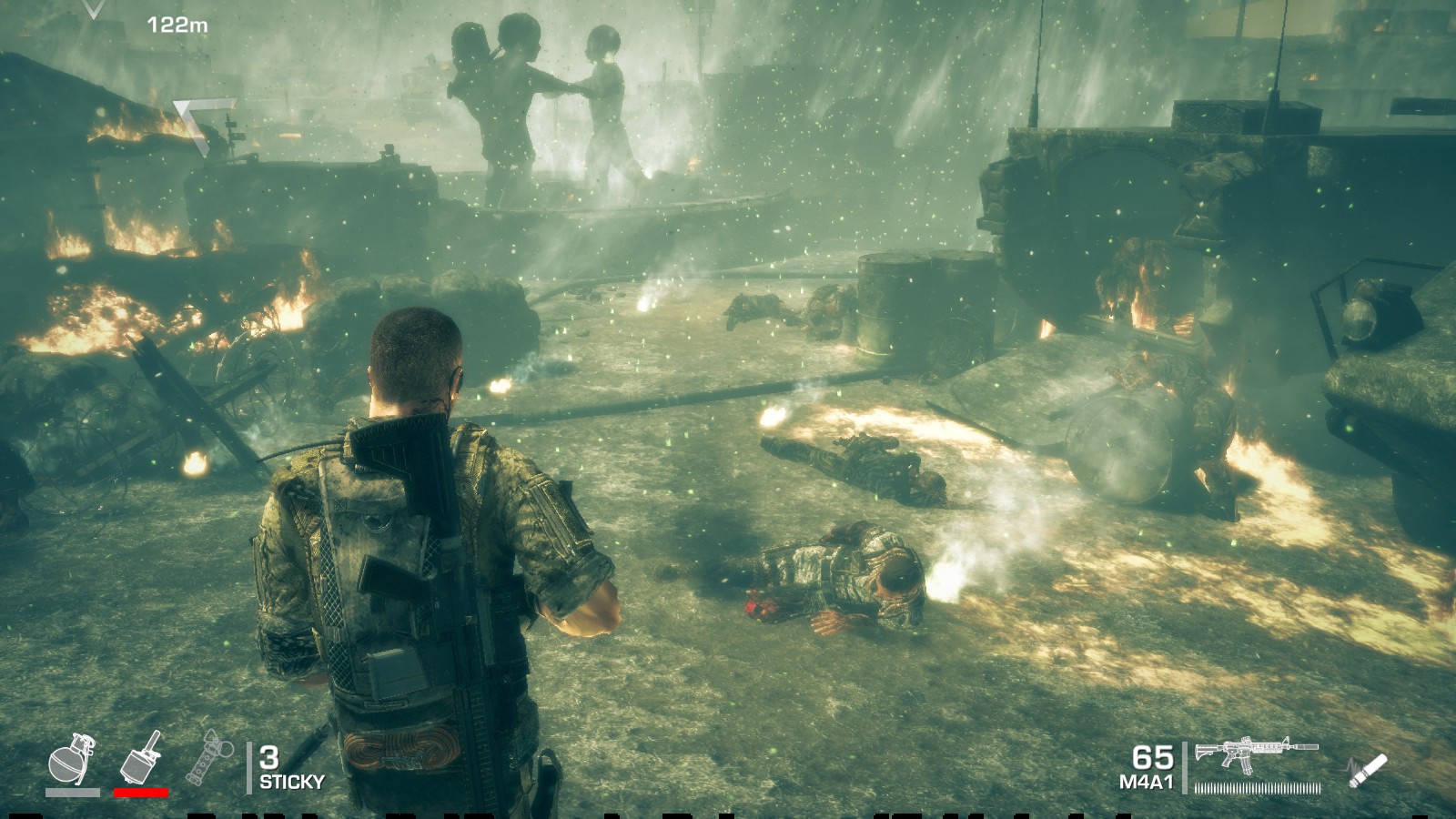
When it's done well, you get Spec Ops: The Line, a game whose story is so stunningly good that it beats the everloving shit out of its recipient seamlessly without once appearing to be disingenuous or preachy.  It is a brilliantly conceived and beautifully executed indictment of the last ten years of war glorification and faux-heroism that our society has collectively indulged in.It isn't a game that's fun in the traditional sense. It hits you hard, but you come out the better end feeling all the better for it.

The narrative is exquisitely put together. It starts out simply enough... you are a Delta Force Soldier sent in with your two buddies to try to find people who survived a huge sandstorm that swept Dubai (something that apparently can happen there). An American distress signal is called and you go looking for it and run into some armed locals. The first hour or two of gameplay are really quite conventional. But then things rapidly change and the story goes to a much different place.

Spoilers from here on. Needless to say, I highly recommend it.

There are three elements of this thing that I'd like to underline...

1) White Phosphorous

This is probably the most talked about scene in the game. Walker has to break through enemy lines and finds a remotely targeted White Phosphorous artillery piece to shell them with. You are transferred to a birds-eye view camera angle where the enemy are little white pips on the ground. You then proceed to let her rip. At first I picked my targets carefully, but after a while I realized that there was no limit on ammo canisters and so I fucking carpeted absolutely everything with the stuff.

Two things happen then.

First you are shifted back to the realistic non-gamey graphics and are forced to walk through the devastation that you have wrought. And it is devastation.


Men are crying and screaming in agony. The disconnect between the feeling of raining death from the sky on little white blips and that moment cannot be larger. These are human lives that have just been snuffed out by your little technological marvel and there's no way even the most uncompromising soldier can just write it off (especially since they're damn American soldiers to begin with).


There's no glory in that victory. No honour.

Then you get to the end and see the true magnitude of your crimes.


Collotaral damage is what they call this, I do believe. Turns out a cluster of the white blips that your computer weapon was firing at was a bunch of innocents. Walker had no way of knowing that would happen, but then again who that ever uses a weapon like that ever really does? You've got your designated military target and you let loose until it's gone. And thankfully, none of the Drone pilots in Nevada even have to give that a second thought, since they don't walk through the aftermath when all is said and done.

But what really made the scene for me was what Walker did afterward... he denied it all. He claimed it was the enemy's own fault that this happened. That they'd brought it on themselves and that his hand had been forced. It's an excuse that is as hollow in the game as it is in reality, but it's the best he can do.

Goddamn.

2) Walker

From White Phosphorous on, it's a downward spiral for Walker. He's going insane and his decisions begin to be coloured by his bloodlust, cruelty and heroic fantasies. Subtle changes start to occur inside of him. At the beginning of the game, when you shoot a hostile American soldier down Walker will cry out "Tango Down!" or some other variety of military lingo.


 Slowly that starts to be replaced by "He's dead" and "And stay down!" The joy in his voice at each death he inflicts is audible. 

But more than that, Walker steadily begins to break under pressure. His orders steadily begin to amount to little more than casual and vicious savagery. When the crew escapes from renegade American soldiers in a helicopter, Walker tells them to circle around so that he can unload the minigun on his former pursuers. There's no reason for him to do this. They can't harm him anymore and it's just unnecessary and wanton destruction.


But he does it anyway. And the why of it is left appropriately unexplored. In an era where the architects of massacres get 0 years in prison, this is something worth reflecting upon.

But the defining moment came when your squadmate Lugo is captured by some Dubai locals. You try to reach him in time, but are too late... they've already hung him by the neck. I really liked Lugo. He was the wisecracker and he had the more human reactions to everything that happened. Losing him felt like loosing a friend.

After it's clear that he's dead, the mob closes around Walker. None of these guys have guns or anything. They're just people who are understandably upset about you shooting up their damn city  like a fucking maniac. I didn't want to hurt any of them. I just wanted to get the hell out of there.

But then someone threw a bottle or rock or something at me and set off the damage alarm. And so I immediately opened fire.


I emphasize the word 'I' there. That was my choice and my own self-preservation instincts. That's what's special about the game. Walker is a fucking insane murderer. But when push came to shove, I acted in just the same way that that cold and despicable mind did. I was Walker in that one moment, callously killing those that would kill me. An animal that exists only to preserve its own pathetic existence.

Goddamn.

3) War.

I can see why the game's writer chose to make the enemy in this game other Americans. Over the last ten years, shooters have gotten realistic in terms of graphics and gameplay, while still keeping the player neatly insulated from the actual feeling of taking another human being's life. Nothing like that in Spec Ops: The Line. Your enemies are basically guys just like Walker.


Have fun killing them!

But there's a definite political undertone here and I want to address it directly.

I protested the Iraq war back when the majority of people thought it was a good idea and to this day I don't think people truly realize why that misguided and vulgar conflict gave rise to so much tragedy. It happened because the Americans were not needed or wanted in that area of the world. It happened because of the eight scariest words in the whole world... "The American Army is coming to save you."

Walker is the embodiment of the Iraqi and Afghan War. He goes into Dubai for a combination of personal and humanitarian purposes and then stays there after things go wrong because he simply cannot stop. He cannot look at himself and say 'I've failed and have done far more harm than good', because then what is the meaning of any of it? Why did he kill all these people if not for some greater purpose? Surely one needs to get to an end that justifies at least some of these means.

But he never gets there and every fucking step he takes forward leads to more death and more misery. If he would just stop where he is and leave everyone alone, everything would be better. But he doesn't. A twisted sense of honour and martial pride lead him onwards, against any coherent reason.

For the last ten years, the world has stayed the course. We've beaten our heads against conflicts that have done far more harm than any good, while inventing new and creative ways to glorify soldiers while dehumanizing the enemy. And that is why Spec Ops: The Line is such an important piece of art. It is a rebuttal against all the fucking ugliness, self-delusion and lies of the last ten years. There is no glory here, no bad guy that you can put down to save the day. There's only the next pointless death, the next pathetic act of self-preservation and the next meaningless conflict.

Walker is us over the last ten years. And we do not look good.

Goddamn. 

Conclusion:

This is a necessary story that will hit just the right audience in just the right place. Glancing through the internet, one of the first comments I read about this game was that it was treasonous. I can think of no better endorsement of this game than that... because right now what the world needs is a little treason.

Treason against the man who killed 24 people in Haditha and walked free...
Treason against the helicopter pilot who gunned down 18 people in Baghdad...
Treason against the Siege of Fallujah...
Treason against the Drones...
Treason against the guy that shot 16 people, including 9 fucking kids, in Afghanistan...
Treason against the last ten years.

Yeah... sign me up for some treason.
There's more ...