Showing posts with label review. Show all posts

Thursday, July 19, 2012

Spec Ops: The Line


In my opinion, the objective of art shouldn't be to simply entertain. That should be part of it, certainly... but there's a huge opening in there for so much more. That's a dangerous road to go down, of course. I mean, when a game says 'hey listen to my awesome philosophy' , then people take out the words didactic and shoot you down though.

When it's done well, you get Spec Ops: The Line, a game whose story is so stunningly good that it beats the everloving shit out of its recipient seamlessly without once appearing to be disingenuous or preachy.  It is a brilliantly conceived and beautifully executed indictment of the last ten years of war glorification and faux-heroism that our society has collectively indulged in.It isn't a game that's fun in the traditional sense. It hits you hard, but you come out the better end feeling all the better for it.

The narrative is exquisitely put together. It starts out simply enough... you are a Delta Force Soldier sent in with your two buddies to try to find people who survived a huge sandstorm that swept Dubai (something that apparently can happen there). An American distress signal is called and you go looking for it and run into some armed locals. The first hour or two of gameplay are really quite conventional. But then things rapidly change and the story goes to a much different place.

Spoilers from here on. Needless to say, I highly recommend it.

There are three elements of this thing that I'd like to underline...

1) White Phosphorous

This is probably the most talked about scene in the game. Walker has to break through enemy lines and finds a remotely targeted White Phosphorous artillery piece to shell them with. You are transferred to a birds-eye view camera angle where the enemy are little white pips on the ground. You then proceed to let her rip. At first I picked my targets carefully, but after a while I realized that there was no limit on ammo canisters and so I fucking carpeted absolutely everything with the stuff.

Two things happen then.

First you are shifted back to the realistic non-gamey graphics and are forced to walk through the devastation that you have wrought. And it is devastation.
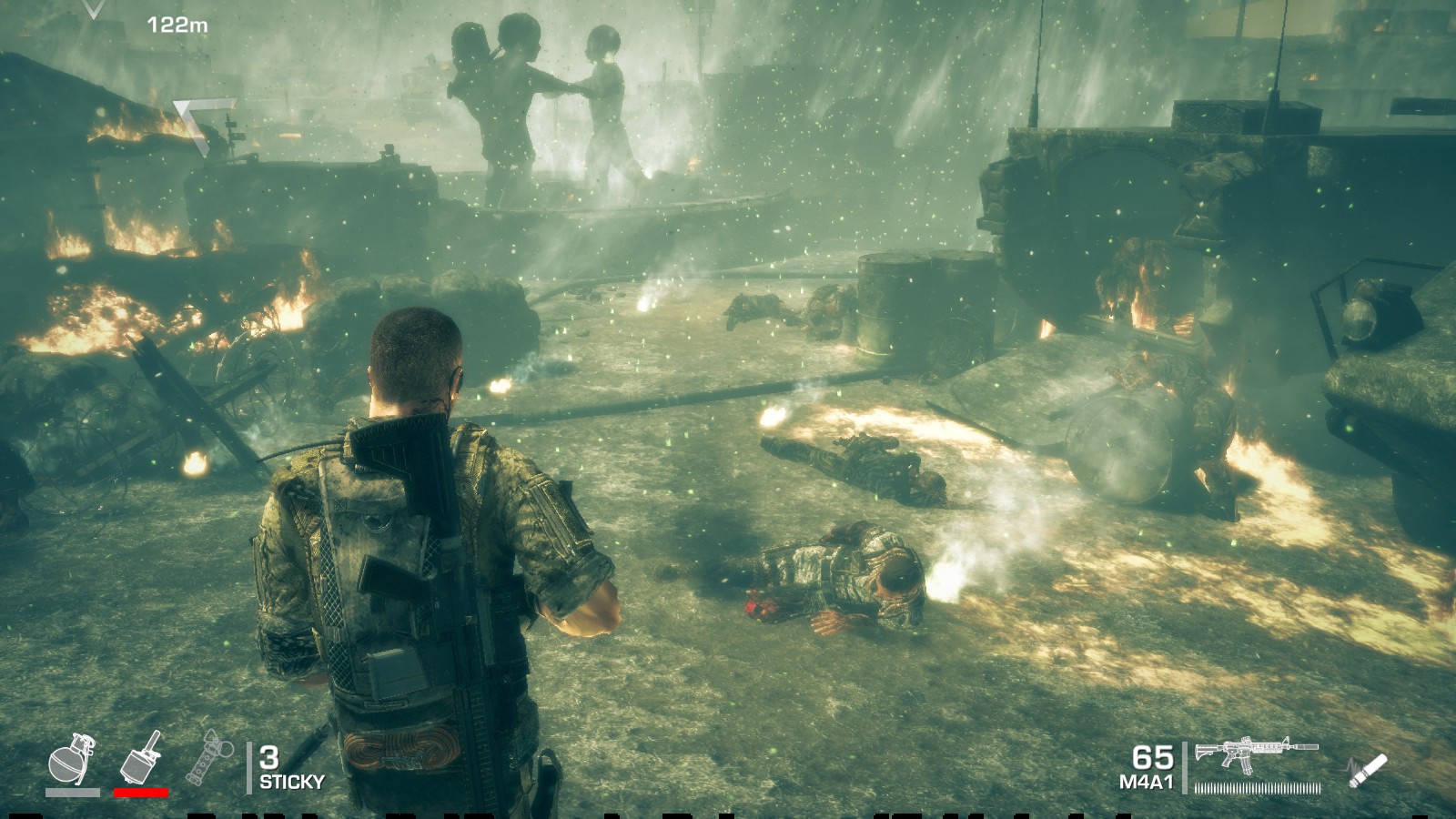

Men are crying and screaming in agony. The disconnect between the feeling of raining death from the sky on little white blips and that moment cannot be larger. These are human lives that have just been snuffed out by your little technological marvel and there's no way even the most uncompromising soldier can just write it off (especially since they're damn American soldiers to begin with).


There's no glory in that victory. No honour.

Then you get to the end and see the true magnitude of your crimes.


Collotaral damage is what they call this, I do believe. Turns out a cluster of the white blips that your computer weapon was firing at was a bunch of innocents. Walker had no way of knowing that would happen, but then again who that ever uses a weapon like that ever really does? You've got your designated military target and you let loose until it's gone. And thankfully, none of the Drone pilots in Nevada even have to give that a second thought, since they don't walk through the aftermath when all is said and done.

But what really made the scene for me was what Walker did afterward... he denied it all. He claimed it was the enemy's own fault that this happened. That they'd brought it on themselves and that his hand had been forced. It's an excuse that is as hollow in the game as it is in reality, but it's the best he can do.

Goddamn.

2) Walker

From White Phosphorous on, it's a downward spiral for Walker. He's going insane and his decisions begin to be coloured by his bloodlust, cruelty and heroic fantasies. Subtle changes start to occur inside of him. At the beginning of the game, when you shoot a hostile American soldier down Walker will cry out "Tango Down!" or some other variety of military lingo.


 Slowly that starts to be replaced by "He's dead" and "And stay down!" The joy in his voice at each death he inflicts is audible. 

But more than that, Walker steadily begins to break under pressure. His orders steadily begin to amount to little more than casual and vicious savagery. When the crew escapes from renegade American soldiers in a helicopter, Walker tells them to circle around so that he can unload the minigun on his former pursuers. There's no reason for him to do this. They can't harm him anymore and it's just unnecessary and wanton destruction.


But he does it anyway. And the why of it is left appropriately unexplored. In an era where the architects of massacres get 0 years in prison, this is something worth reflecting upon.

But the defining moment came when your squadmate Lugo is captured by some Dubai locals. You try to reach him in time, but are too late... they've already hung him by the neck. I really liked Lugo. He was the wisecracker and he had the more human reactions to everything that happened. Losing him felt like loosing a friend.

After it's clear that he's dead, the mob closes around Walker. None of these guys have guns or anything. They're just people who are understandably upset about you shooting up their damn city  like a fucking maniac. I didn't want to hurt any of them. I just wanted to get the hell out of there.

But then someone threw a bottle or rock or something at me and set off the damage alarm. And so I immediately opened fire.


I emphasize the word 'I' there. That was my choice and my own self-preservation instincts. That's what's special about the game. Walker is a fucking insane murderer. But when push came to shove, I acted in just the same way that that cold and despicable mind did. I was Walker in that one moment, callously killing those that would kill me. An animal that exists only to preserve its own pathetic existence.

Goddamn.

3) War.

I can see why the game's writer chose to make the enemy in this game other Americans. Over the last ten years, shooters have gotten realistic in terms of graphics and gameplay, while still keeping the player neatly insulated from the actual feeling of taking another human being's life. Nothing like that in Spec Ops: The Line. Your enemies are basically guys just like Walker.


Have fun killing them!

But there's a definite political undertone here and I want to address it directly.

I protested the Iraq war back when the majority of people thought it was a good idea and to this day I don't think people truly realize why that misguided and vulgar conflict gave rise to so much tragedy. It happened because the Americans were not needed or wanted in that area of the world. It happened because of the eight scariest words in the whole world... "The American Army is coming to save you."

Walker is the embodiment of the Iraqi and Afghan War. He goes into Dubai for a combination of personal and humanitarian purposes and then stays there after things go wrong because he simply cannot stop. He cannot look at himself and say 'I've failed and have done far more harm than good', because then what is the meaning of any of it? Why did he kill all these people if not for some greater purpose? Surely one needs to get to an end that justifies at least some of these means.

But he never gets there and every fucking step he takes forward leads to more death and more misery. If he would just stop where he is and leave everyone alone, everything would be better. But he doesn't. A twisted sense of honour and martial pride lead him onwards, against any coherent reason.

For the last ten years, the world has stayed the course. We've beaten our heads against conflicts that have done far more harm than any good, while inventing new and creative ways to glorify soldiers while dehumanizing the enemy. And that is why Spec Ops: The Line is such an important piece of art. It is a rebuttal against all the fucking ugliness, self-delusion and lies of the last ten years. There is no glory here, no bad guy that you can put down to save the day. There's only the next pointless death, the next pathetic act of self-preservation and the next meaningless conflict.

Walker is us over the last ten years. And we do not look good.

Goddamn. 

Conclusion:

This is a necessary story that will hit just the right audience in just the right place. Glancing through the internet, one of the first comments I read about this game was that it was treasonous. I can think of no better endorsement of this game than that... because right now what the world needs is a little treason.

Treason against the man who killed 24 people in Haditha and walked free...
Treason against the helicopter pilot who gunned down 18 people in Baghdad...
Treason against the Siege of Fallujah...
Treason against the Drones...
Treason against the guy that shot 16 people, including 9 fucking kids, in Afghanistan...
Treason against the last ten years.

Yeah... sign me up for some treason.
There's more ...

Friday, March 16, 2012

Mass Effect 3 - "So slow. So clumsy. Pathetic!"


I know that I never update this place anymore, but I figured I may as well revive it to talk about Mass Effect 3.

My review of the first Mass Effect was actually the first real post I ever made on this blog. Looking back at it, I was pretty unimpressed and to this day I stand by everything I wrote in there. Mass Effect's premise is completely derivative piece of science fiction with not a single decent original idea under its name. That was true then and it's still true now.

The question then becomes why I played two other entries in the series when I thought the first one was trash. The answer to that is two fold. For one, the gameplay got a major facelift in part 2. I could take cover behind blocks that no amount of futuristic weaponry could pierce and then shoot things. But the story also shifted in focus from rip-off world building to something more character based and thrived as a result.


Sure the world was still a rip off of various pieces of fiction, particularly 40k of all damn things. Like oh no, the colonists are being mind controlled and carted off into the scary bio-vessels. That's almost as bad as when the Genestealers did it. But even if the story wasn't super fantastic, at least I was enjoying it with characters I actually could like and I could at least feel as though my decisions as the Shep was affecting the outcome. I didn't like it so much that I played through it twice the way other people did, but it was still good.

And so it was that I found myself getting genuinely excited when the third one started to roll around. I would get to hang around Garrus, Tali and Mordin again and cart around the ridiculous Mary Sue known as Commander Sheperd so that I could save the galaxy from the Necrons.


And so it was that I could set out to save Earth again, smiling indulgently as the game melodramatically focused in on some little white boy getting killed and then told me to start building the Ultimate Macguffin. I got to imitate Picard as I saved a barbaric race from extinction and I got to rehash that one episode of TNG when I declared that robots have souls. I fought against an assassin who was Asian and therefore decided that using a sword in a science fiction setting centered mainly around guns was the way to go.

And you know, it was good. Sure the world around me and the story that was unfolding was still this ridiculous hack melodrama, but I could at least kick back and hear Garrus deliver lines about how I'm the damn best soldier ever or have Tali tell me she loved me as I went to kill a Reaper with a laser pointer. And I liked being able to pick dialogue options and watch Shep say and do cool things, because it let me believe that I was actually that eloquent and heroic.

The story was ultimately just a mishmash of other things, but even if I'd seen it all before it was all in such a nice and pretty package of top-notch voice acting, strong characters and fun run-and-gun gameplay. And so I enjoyed it. Hell, I frickin' loved it.

But then at the end of the game, I think Bioware made the biggest mistake that it could ever make: They had an original idea.

A series so heavily rooted in cliche like Mass Effect needed a cliche ending. You know what I'm talking about... the kiss followed by the walk off into the sunset. Or even a 'you become Emperor of the Universe' type deal. Anything of that nature. But Bioware, so inflated with their fan's praise, somehow decided that they were artists here. That they weren't just people that put stuff that other, better, authors and artists have done into a shiny package.

And so, at the last minute, they took a stab at originality.

The result was a pseudo-philosophical abomination that has soured the entire franchise like nothing else ever could. An ending so rancid that it has provoked spontaneous charity drives to protest it and shook the very internet to its core.

I don't think I need to talk about it at length. Lord knows that you can find commentary aplenty on it elsewhere. If Bioware has committed one sin, it's this:

Hubris.
There's more ...

Saturday, March 5, 2011

The Wise Man's Fear - The cut-flower silence of a man waiting to die


Go read this book. Right now.

Done? Okay. Let's talk.

So Pat Rothfuss is quite the guy.

He's got a way with words. The sheer amount of skill that comes out in his phrasing, sentence structure and paragraph length is just breathtaking. Rothfuss is poetic without being overwrought. He's clever without being silly. He can describe a song so well that you can hear it and magic so well that it feels like you could try doing it yourself.

His characters are well measured and structured. With a sentence here or a word there he can convey a character trait that would take a lesser author a good 10 pages to convey. And more importantly, they feel like real people. Whenever Rothfuss strays near an archetype (i.e. mean old noble guy) he'll salt something in to differentiate them. Screentime is carefully managed to leave the reader with the correct impression of a character.

I have been of the opinion for some time that Rothfuss is in fact the best author currently making use of the English language. We are privileged to live in his generation. While I was reading this book I did little else. When I walked down the street, I had my Kindle in hand reading. When my Associate turned his back, I would pick up my Kindle and read. I've been reading the book at every opportunity for the last 4 days.

Having finished it now, I am in awe of Rothfuss' skills and wonder how it is that a man of such incredible powers could make so many mistakes.

There are three ways in which the Wise Man's Fear disappoints. Let me emphasize again before I begin that this is still the best book written between the release of the Name of the Wind and now.

SPOILERS AHEAD


Flaw #1 - Plot

I really think what Rothfuss did right in the Name of the Wind was to take a step away from the World Building style of fantasy that plagues the genre these days, choosing instead to leave most of that stuff aside so that he could run a tight-plot. Even as Kvothe mucked about in the University and fought a Draccus, the plot never loses sight of the Chandrian

The Wise Man's Fear, on the other hand, does just that.

Going on a trip to Vintas to visit some Lord guy? Cool, that broadens the setting.

Fighting some bandits? Well okay, I guess that's how everybody gets their start.

Having sex with one of those slutty Great Faeries from Zelda? Oka-... wait, what?

All of the encounters are linked back to the main story just so clumsily. Kvothe getting information from the head karate lady in the one town just felt video game-ish, with Kvothe asking for what essentially amounted to a Quest Reward.

And honestly, where did the main plot really even go in this? Besides a brief Cinder cameo with the bandits and a few repetitive rumours (I know there are fucking seven of them and they don't like the Atur, let's move on), the Wise Man's Fear offers next to no new information. There's a list of names sure and you get how they knew someone was singing about them, but there's no more information about what their problem is. Honestly, I've waited for this for years and this is all I get? Surely some of the information coming in the third book could have been moved up into two.

Flaw #2 - Pacing and Kvothe's powers

A lot of the things in the book easily overstayed their welcome. Kvothe's training with the Adem is the first thing that springs to mind in this list. That was just pure World Building Fantasy. Chapter after chapter doing little more than exploring the eccentricities of these weird Karate People's culture. I don't understand the reason why that had to last as long as it did. I mean, maybe if the whole Lethani thing were linked a bit more closely to finding the Name of the Wind it would have been a bit better, but the whole thing seemed pretty arbitrary.

I also think that on one level Kvothe is getting a bit silly. In the Name of the Wind Kvothe was an eternal underdog, but now he's a Rich Magic Karate Singing Sword Man (who's great in bed). I know it's all going to fall apart nonetheless and sink him into a shitty inn in the middle of a bunch of shit farms. But did he really even need to learn all that martial arts shit? Personally I think sticking with goddamn magic would have been a lot better. That stuff he did when he used sympathy on a corpse to slit those bandits' throats was fucking awesome. I'd much rather he do shit like that then go around using obscure Karate.

I did really like the poem about beating up the 10 year old girl though.

And it was a bit of an odd choice to make the Karate moves and the sex moves have such similar names. "Thousand Hands" vs. "Sleeping Bear", etc.

Flaw #3 - Women

Okay. Let's start with the more minor problem...

So I remember Rothfuss once describing himself as a casual anime fan, but... well, I don't think that's true and that he's minimizing that. Because the first chunk of the book in the University really did read a lot like a harem anime. An Event here with Devi (Tsundere-type), another one there with Mola (Senpai-type), another with Fela (Idol-type) and another one there with Auri (Mysterious-type). Like a harem, none of these things were allowed to come to a natural conclusion. Kvothe would have a meaningful scene with one of them and you'd think 'oh okay how is this going to develop?' only to have him a similar scene with a different girl in the next chapter.

Pure harem. That isn't a major crime in and of itself, but it certainly was an odd choice.

But then there was Felurian.

I think I was hoping for a more Jonathan Strange/Mr. Norrel path into the fae lands, but I can get over that. If I could describe the way those chapters were written as anything it would probably be self-indulgent. His decision was his decision. It was certainly interesting to see Rothfuss amazing powers of writing employed in something so raunchy.

But what I don't like is what it did to Kvothe's character. Whenever Kvothe meets a pretty girl I must now ask the question 'Is he going to sleep with this lady?' On average, the answer in the WMF after the whole Felurian thing appeared to be 'yes' (unless she was underaged, which is a small mercy). Rothfuss in this regard seemed to be expressing a sort of promiscuous philosophy at times so I was glad when Kvothe's dalliances resulted in him being shut down with Denna. At least that shows that Rothfuss is aware of the limitations of that philosophy, but I nevertheless don't think that Kvothe being a man-slut serves his character very much.

Also I really don't like Denna. And her patron is almost certainly a goddamn Chandrian.

Nevertheless...

This was a fantastic book. Brilliantly written, well-structured and well-executed. I am eager to see how the plot will develop and look forward to having some friends read it already so that we can discuss questions as to Chandrian identities and where the heck Skarpi or Bast are or how Kvothe should just forget about that Denna bitch and focus his attentions on Auri.

There's more ...

Sunday, December 19, 2010

The Disappearance of Suzumiya Haruhi


So I just watched this Disappearance of Haruhi movie (that's what it says up there)

Haruhi as a series has gone through an interesting arc. When I first watched the series, my only reaction was 'wow fucking awesome'. There you had this really weird and meta series, told out of order with quirky characters. Sure a lot of its ideas were lifted from some of the pillars of western science fiction, but it's okay to take ideas and recontextualize them. As far as I was concerned, that was a great series.

After that I hit the novels and discovered the uncomfortable fact that they were awful. The majority of the Haruhi novels, regardless of translation quality, are absolute unfiltered shit and the author is a talentless hack. The author tells obscure time travel stories and has characters say things like 'you wouldn't really understand' to paper over the glaring plot holes he introduces. Rather than exploring concepts he introduces, he leaves them half baked and starts throwing in new ones. The whole series is a complete fucking mess and was only made presentable by a really savvy director who knew how to spin lead into gold.

But the one time I would say that the guy almost got it right was in the Disappearance of Haruhi Suzumiya. After watching the movie version, I am reminded of what the key word in that statement is: Almost.


So the basic plot of Disappearance is that someone (guess who?) has modified the universe so that Haruhi's disappeared and the rest of the SOS Brigade are all normal. Everyone's lost all memory of how things were except for Kyon, who is doing his best to restore the universe to the way it used to be somehow, though as he does so he's confronted by a 'normal' Nagato who quite obviously likes him.

So let's be clear: there's only one genuinely good character in Haruhi.


Mikuru is always just Mikuru, Koizumi never breaks out of his basic 'fruity esper-with-no-real-powers exposition boy' role and Kyon is just an (extra whiny) everyman. Haruhi herself is often described as being an unpredictable eccentric, but she's so predictably and unchangingly eccentric that to me she's just really a brat that's used to always getting her way without fail.

Nagato on the other hand is a character that actually has had some development as a character, or so I thought. She's this alien robot superlady that's confronted with human emotions (particularly her feelings for Kyon) for the first time and having trouble dealing with them. Recipe for success right there. So Disappearance, which is about her, should have been a winner.

It's not. At least not mostly.

The problem with Disappearance is that it's fucking terribly written. The first Haruhi season prospered because for the most part the author's storytelling style was set aside in favour of a more meta approach. This movie was basically a one to one conversion of the novel to the big screen and as a result it is absolutely terrible.


The pacing is a mess. The movie will move between Kyon wallowing in self pity, not knowing what to do, before arbitrarily stumbling on a clue and springing awkwardly into action. A good 30 minutes of the movie is dedicated to Kyon agonizing over whether or not he wants to stay in the peaceful 'normal' universe or go back to the crazy Haruhi universe and each moaning session comes to the exact same conclusion (he wants to go back to Haruhi world, I fucking get it).


The plot is incoherent. So much of the time travel mumbo jumbo is explained away with 'you wouldn't understand' that it just pisses me off. How did the time travelers even remain unaffected by Nagato's time warp? Why does Mikuru Senior know to expect Kyon?

But even beyond that, there's little dramatic unity in Disappearance. Sometimes it's a Nagato love story, sometimes it's about Haruhi and sometimes (when it gets really bad) it plays at being a sci fi thriller. All the disparate elements don't jive together at all and considering that literally nothing is resolved in the story (this is only novel 4 of 10 after all) it's really not a very satisfying film to watch.


Don't get me wrong, there are some great scenes in there. I'll be honest: I really do adore Nagato. The idea of an alien artificial intelligence going through Data's classic struggle to attain humanity (except with the romance angle thrown in) appeals to me greatly. Her character design is spot on and the voice of Chihara Minori is as powerful as it's always been.


Seeing those ideas explored thoroughly, even if it's only for about fifteen minutes in a 180 minute movie, was worth it I think. All of it is sloppily stuffed back into an arbitrary status quo shortly after that, but for that one shining moment Disappearance becomes a good movie.


That moment, however, is fleeting. Every character in Haruhi is stagnant and the story as a whole doesn't go anywhere. Six novels from now, Yuki will still be an android alien intelligence struggling with her human emotions (particularly her feelings for Kyon), with no real progression. Everyone else stays as everyone else. More bullshit is introduced, but the status quo remains uncontested.

And that just isn't good enough.
There's more ...

Friday, August 13, 2010

Scott Pilgrim vs. The World


Scott Pilgrim was bloody great.

Comedy and action. Amazing direction and fantastic writing. Fun music, great nerdcore references and spot-on acting. I really don't have anything bad to say about this movie. The only thing I can say against it is that occasionally people in the theater were laughing too hard, which made it hard to hear some of the jokes. But that is not a cause for serious concern.

If you have any sense, you'll see this movie. Everything you want in a movie is in this film. A guy fighting against seven evil ex-boyfriends for the sake of the love of his life. It's honestly the best movie of 2010. Yeah that's right, fuck Inception. And if you're from Toronto it's basically mandatory viewing.

Watch it immediately.

Anyhow let's talk about it...

First of all, I've pointed this out to many people before but it bears repeating for those of us who weren't raised on Super Mario Brothers.

This is a Bob-Omb (of the non-sexual variety):


That aside, I've been a fan of the comics since a friend introduced me to them in the Second Cup that Scott's sister works at. After I read the first volume there, we went to the park where Ramona and Scott go to (the one with the swingset). Close to home, no?


It's great to see Toronto moving up the cultural ladder a bit. This is really a city that gets no damn respect. It's always New York or LA or Paris or London. When a city in Canada is used it's going to be fucking Vancouver or Montreal or something. Unless it's a fucking Robert J. Sawyer novel or something, Toronto doesn't really exist. And Robert J. Sawyer's portrayal of Toronto is just really a name with no soul. Scott Pilgrim is probably the first thing I've seen that's really captured the spirit of my city.


Emphasis on the word spirit. It's not just a matter of familiar locales and landmarks, it's a matter of actually showing the character of the people who live here. Scott Pilgrim's brand of a shy/sincere nerdy/somehow cool sort of guy is a prime Toronto specimen. Scott Pilgrim could easily be the guy I bought this computer from or one of the assholes I play Left 4 Dead with. I guess in the comic he's more plain old crazy, but in the movie that's less apparent. But the point I'm trying to make is that this is that this is the first work of fiction set in Toronto made by someone that seems to really love Toronto in a non-superficial way. The movie is sort of a love letter to the entire city.


I don't think it's just the Toronto thing that made it good though. My favourite part of the movie was the fight with Lucas Lee. It's a brilliant scene for a lot of reasons... the stunt doubles thing, Lucas' awesome lines ("The first click will be me hanging up... the second will be me shooting you dead!") and the awesome direction to name a few. When he went for coffee as the stunt doubles beat on Scott I was just cracking up.


That's an amazing scene no matter what the context is. The fact that that was Casa Loma and that I sometimes go and sit on the steps Lucas skateboards to read sometimes is just really an extra bonus.

I kind of like that. This is Toronto's movie. Anyone else can see Scott Pilgrim and love it. But only people from this city can truly appreciate it. And even among that select few, not many can appreciate the way I can. I mean, I live just down the street from Scott after all.

But anyhow, Toronto aside...

One thing I especially liked was getting to hear the music. A comic can't really convey what a song is supposed to sound like. I'm listening to the soundtrack right now and it's actually kind of bad, but that actually fits the fiction quite well. The Sex Bob-Ombs are supposed to suck. That's explicitly spelled out in the canon. I see that Beck did a bunch of the songs, which is a band that's big enough for me to actually know of them in spite of my obscure musical tastes. I imagine that they thus weren't actually trying to suck. But well, in spite of their best efforts, things worked out!

Plus this thing was fucking awesome.

Knives Chau was done brilliantly, but I think they made her click with Scott a bit too much at the end. It made it feel just weird when she just gave up in the end. If there's one thing I think the movie didn't handle too well, it's probably that. But that is extremely minor.


I think Ramona was pretty perfect. That sort of elusive air they gave her was nice and I liked the actress. I didn't think I would when I first saw her, but she more or less was the way I always imagined Ramona to be. Tough, smart independent, bit bitchy but still very cool. Pretty enough to justify the infatuation too. I think the problem with the trailers is they mostly showed the pink haired incarnation rather than blue or green.

The text stuff worked really well. Really kept the story going along at a good pace. I'm not sure how someone who hasn't read the comic would react to it, but I felt the pacing was pretty much perfect.


They also started to the Ninja Gaiden showdown a few times, but never did the finish. That was in the comics once or twice (I think that's how he finished the girl, I can't remember). They should've gone all the way with it. It's a classic.

So yeah, overall Scott Pilgrim was a great movie that everyone should see, particularly anyone that lives in Toronto. It was made for us and we should appreciate it.
There's more ...

Friday, July 23, 2010

Inception


Going to make this one quick.

I liked the movie, but I feel like I'm still going to end up being a bit of a killjoy here because I'm going to mainly be talking about why I didn't like it that much. So let's first talk about why I liked the movie in a quick and dirty 1-2-3 list.

1) It's nice that Nolan trusts in the intelligence of his audience. The dream scenes got pretty complicated with the different time frames and time going slower in one scene than it is in the next. It was fun to keep track of all that without too many stupid visual clues with close ups of watches and shit.

2) The fight scenes were neat. I liked how the physics of the dreamworlds overlapped, with the van in freefall resulting in no gravity in the hotel and all that stuff. That was pretty unique and tense, although somewhat subverted by the fact that if the guy on the upper layers actually lost the other scenes would just collapse (and you knew it wouldn't end like that).

3) Witty banter, good music and a fairly original premise kept me interested. Little funny moments like the firefight that Eames ended abruptly with a grenade launcher helped piece this together.

So in other words, it was a popcorn flick. A few hours of good honest fun. If you want to see a movie that you can spend a few harmless hours enjoying, then Inception is a good pick.

Here's why it's nothing more than that:

1) Leonardo DiCaprio.

At no point in the movie did I find Cobb's character to be convincing. The story with his wife and kids, his emotional problems, his character as a smart dream spy guy... really everything about the guy just seemed so flat and artificial. I think he was a fine character on paper, but the problem is that Leonardo DiCaprio is a ham actor who had no business playing this kind of part.

The whole movie I was wondering why Nolan hadn't gotten Aaron Eckhart or raised Heath Ledger back from the dead or at least hired some sort of actor instead of a damn aging pretty boy that can read a script in an Acting Voice. It's especially weird since everyone else in the cast put on a fairly strong and convincing performance. Did Nolan think people wouldn't notice how fucking terrible DiCaprio is if he surrounded him with talent perhaps?

2) "You mustn't be afraid to dream a little bigger, darling" is a nice line, but the movie really did seem to be quite afraid to dream a little bigger.

Everyone has a different way of dreaming. When I dream (and remember it) it is usually a long tragic narrative, but other people just see images of sheep eating grass or something. What more or less everyone agrees upon, however, is that in a dream anything is possible. You can fly, you can breathe underwater, you can shoot lasers out of your eyes and lightning out of your fingers.

In Inception, everyone used guns. Nothing else. There's one instance where that one guy used dream magic to use those 'paradox' stairs to get the drop on a projection, but that's really just about it. You could argue that they can only use the things that the architect provides before they go in and that she isn't supposed to twist the world too much lest they attract the attention of the projections, but she's shown to have the ability to affect dreams on the fly. Why didn't she just manifest a fucking giant fire breathing robot dragon when things started getting ugly? What was stopping her? She could have hidden the thing when Fischer was around.

It feels to me that Nolan just wanted dream gun battles and nothing else and so nothing else was put in.

3)It was predictable.
I feared at the very beginning of the movie that it would end with some bullshit 'it was a dream the ENTIRE TIME and he was just trying to get the last secret from the Japanese guy' ending. I was relieved when it was apparent that that wasn't the case, but everything else was fairly predictable and straightforward. DiCaprio's wife being the first inception target and the entire story with her could really be traced twenty minutes in advanced.

This isn't necessarily a bad thing, but when you combine it with the fact that I never gave a fuck about Cobb or anything related to Cobb thanks to the ham acting of Leo DiCaprio you get certain stretches of the movie that are really fucking boring. If I'd had control in the theater, I would have skipped a bunch of those fucking scenes and just gotten back to the people with funny accents shooting assholes.

And that's about all I've gotta say about that.
There's more ...

Wednesday, July 14, 2010

The Gentlemen Bastard Sequence

Scott Lynch's The Lies of Lamora Locke and Red Seas Under Red Skies are a really good pair of books, which is surprising considering how much they do wrong.

The basic plot is that you have a Thief Priesthood preying on a fantasy city with a whole lot of alchemy and such cramed in. The main characters Locke and his gang, who are a group of con-artists that prey on the rich with elaborate confidence schemes who then get caught up in underworld politics and tangled in all manner of complications.

The characters are well-realized and human. The plot twists and turns in surprising ways and the books are most certainly page turners. I read the second one cover to cover in one sitting. But unfortunately, Lynch suffers from an affliction that many Fantasy authors suffer from. Mainly: the guy loves his fucking world building and refuses to put that shit down.


World building is an exercise that every bit of speculative fiction needs to go through. Readers need some context if they aren't going to be in some form of Earth that they're roughly familiar with. If Earth has been enslaved by alien crabs you need to establish that much before starting the rebellion against the crabs. But the problem of the last decade of Science Fiction and Fantasy is that world building was been placed at the forefront when it's supposed to be in the background.

In my opinion, nothing illustrates this trend better than Lynch. Every three chapters or so, the man would call a halt to his actual story and do some world building. He'll literally leave the real plot on a coathanger somewhere and go on for twenty pages about a random world building detail that he apparently feels is more important than his actual fucking story. It's almost always unnecessary and breaks the immersion like a crying baby in the middle of the Dark Knight.

Some examples of the shit Lynch foists on the reader in the middle of his narrative:

- The cruel aristocratic Chess-with-peasants-as-pieces game of some obscure palace
- How a bunch of hookers rebelled against their pimps
- The rituals of the freaky death goddess cult

There was one part of the second book where Locke and his friend Jean are getting trained to be seamen. The first worldbuilding detail Lynch put into that sequence was something that I liked... a seaman superstition that it was deathly bad luck to go out to sea without a cat aboard the ship, lest you offend the Iono the Lord of the Grasping Waters who apparently is very fond of cats. That was a cool detail that I thought was hilarious at the same time. I mean it's not often you see a Fantasy author taking inspiration from lolcats


But nevertheless, that one good moment was soured somewhat by the fifty fucking pages of fantasy sailor jargon ("Hard to Larsboard!") that followed it. Fuck.

Don't get me wrong, the world that Lynch has put together is pretty cool. It's got a really interesting set of political institutions, a nuanced criminal underworld, a well-realized religious angle, alchemy, clockwork machines, elaborate poisons and even a bit of diplomatic intrigue. Lynch even knows when to hold things back and keep them mysterious, as he does with a certain society of sorcerers for instance.

And fuck, he has cats in pirate ships:


But world building should be context. World building should be background. World building should be subordinate to everything else that's in the fucking story. World building should never be the story itself.

That said, the book has many virtues to make make up for this flaw. Let me go through them quickly so that I'm not just writing a negative review for a pair of books that I actually liked.

#1: Strong characters.

I'm a big fan of trickster protagonists and as the title of the first book suggests, Locke sort of embodies that. Trying to guess when he's lying and when he's not is what keeps the pages turning for me. As you read along and get a feel for his value system and personality it becomes easier to tell (which takes a bit of the joy out of it) but well-told and surprising lies are still in great abundance.

Unfortunately his world building mania does cloud into some of the more minor characters in the story. Like the Pirates (Plural! More than one!) who love Poetry and have long discussions about it. But fortunately that shit is minimized

[Note to Lynch: I get it, by the way. Lucarno is Seneca/Roman poets. The other guys were Sophocles/Greek poets. Thank you for inserting the discussion you had in a first year Classic seminar into your book. That was a very necessary thing for you to do.]

#2: Good planning.

The first two books have all manner of references to a girl that broke Locke's heart and left him, with no details or explanation. One thing that kept me reading so quickly was my curiosity about who the hell she is and why/how she did that and where she is now. In two books, Lynch avoids giving any tangible details. That tells me that he has the next five books in the series tightly planned and I strongly approve of that.

#3: Excellent fight scenes.

This one speaks for itself. Dirty thief fighting is full of quick movements, with dodges and distractions and feints. Often a fight in fantasy will rely on a character's gimmick or feel DnDish. Lynch's fights on the other hand seemed very real, with good accounts of pain, fear, hesitation and rage. I always like an author who pays attention to the physical nature of combat.

#4: Pirate cats.


Seriously.
There's more ...

Tuesday, January 26, 2010

Star Trek Online - "You betrayed your uniform!"


Star Trek Online is the best MMO ever made. But that doesn't mean it's good.

The game has two portions... a Starfleet Command style ship combat system that's fairly sophisticated and pretty fun, along with a ground combat system that is awful. Most of the game takes place in space however so it's good on average. Like Guild Wars, the game uses an instance system and thus I went through the majority of the beta playing by myself and eschewing any and all contact with my fellow human being.

The gameplay of the average MMO is not fun. WoW fights boil down to finding an enemy, attacking them, pressing your hotkeys for special skills and hoping to kill them before they killed you. Party play took that central concept and made it somewhat grander but did not change the fundamentals. Star Trek Online is thus unique in the sense that basic space combat is actually a fairly fun game in its own right.

But unfortunately, that in turn begs a simple question: Who the fuck got all this MMO into my single player game?

So the first thing you do in the game is create a character.


At first I was trying to make a girl that looks like Jadzia Dax, but while playing around with the sliders I noticed that it's perfectly possible for me to make a Starfleet officer that looks like she's maybe 12 or 13 years old. After thinking "I would totally watch that anime" I created the first lolita Starship Captain in order to see how long it took some Star Trek douche to hit on me.

Thus was Atera Kell born and the answer to the hit-on question was five minutes after completing the tutorial. Oh Star Trek fans, you guys are just so predictable.

In any case, the character of Atera Kell in my head was a Wesley-ish Child Prodigy that was given her own ship because really Starfleet's standards are THAT low nowadays. Anyhow, this was funny for a while but by the time I became a Commander I was a bit tired of looking like a 14 year old girl and thus broke out the char creator again and aged her...


I actually really like the way you can change your look at a moment's notice. You can also hide things like body armour and such so that you can make a nice customized Federation uniform as I did above. It lets you really feel like you're progressing as you go along and makes your character feel a bit more consistent. You don a different uniform as you rank up, rather than simply put on whatever you find on Klingon corpses. I actually thought it was pretty cool when I became a Captain and changed my look to this:


Neat.


You can also customize the look of your crewmembers. From left to right there you have Ensign Kayla, Lieut Commander Olox (my Security Chief), me, Chief Engineer Takara and my medical officer Sha'kar. I spent a fair bit of time tweaking their appearances.


I especially like how Olox came out. Imposing Bolians are cool.

Anyhow, so this is pretty solid so far, I'd say. You have a ship... you have a crew... you fly around the galaxy shooting other ships and beaming down to planets to shoot dudes. Why's it so bad?

Reason #1: It's an MMO.


A random crewmate will be selected to read some quest dialogue ("Sir there are some Klingons here, let's kill them). I suppose the reason for this is that you aren't supposed to be chatting with NPCs, you're supposed to be chatting with other players. But that isn't how Star Trek is. In Star Trek social development is directed inside the ship, with only occasional appearances by Admirals and other Captains. In this you're in a fleet battle against 10 Borg Cubes every few moments.

That's not what Star Trek is like! Voyager sucked! Stop ruining the Borg!

I rarely grouped up in the game because that's how Star Trek should be: a single ship going around the galaxy, having its own little adventures. But at no point will you get any genuine personality from your officers. They're literally just upgrades for your ship that you take down on away teams.

I would really prefer a single player game with that sort of interaction. I'd like to be able to hear about how Olox lost his barber father during a Borg attack on the Enterprise or whatnot. I don't really have much interest in having five ship Captains beam down to a shitty planet to scan for microbes.

Which brings me to...

Reason #2: Scanning for Microbes.


Or rocks. Or lava. Or archeological artifacts. Or... whatever. Exploration is the essence of Star Trek and they tried to put it into this. This turned out to be just beaming down to a planet, finding a couple of rocks (usually 5), hitting 'scan' and then leaving. It's really boring and really pointless. Sometimes they'll be some random enemies loitering around the microbes which you have to kill before you scan, which isn't really how Picard did it in my memory.

What would be better is if they did what is done in the shows and used these silly missions to develop some of those bridge characters. When you do the missions with other people it's just a bit of the other dudes like 'this sucks' as everyone runs in every direction to find the shit. I would kill to have them use it as a platform for character development, but that sort of thing is possible only in a single player game.

Reason #3: The story is bad.

It's set thirty years after Nemesis. In true nerdish overcomplexity tradition, let me explain reason #3 in three parts.

#1: Bending over backwards to make references and connections to the original series. Stuff like this:

Ich.

#2: Complete unoriginality.

Almost all the missions are rehashes of old Star Trek episodes. There was a Section 31 mission that involved a long 'test' exercise on the Holodeck, like that Bashir episode of DS9. There was a mission about the Hirogen doing some bullshit that was not far removed from the shit they did to Voyager. There's a mission that's like that episode of DS9 where some Jem'Hadr have a Gateway. It's like they think that if something can't be directly connected with an episode, the fans will revolt. I guess this must be what Star Trek novels are like.

#3: It's stupid.

The game is based around combat. You can't hail a Romulan vessel and do a bit of cowboy diplomacy to get them to cut out their shit. You have to open fire immediately and the way they try to justify your doing that is often just retarded. Without going into the painful details, let's just say that there is no fucking 'neutral' zone anymore if I'm going into Romulan territory and destroying their ships.

And honestly:


Holographic ships? Fuck if you can have those why bother doing anything else ever.

#4: Ground Combat


It's really bad.

It has two issues that I would think any developer would be able to catch. The first issue is that the enemy does not deal enough damage. I didn't put much thought into my away teams. Two Tactical Officers, an Engineer, and a Doctor (I'm also a Doctor). The enemy could never even put a dent in me.


The second issue the worst possible thing you could combined with the first. They have WAY too many hitpoints. It takes FOREVER to kill ANYTHING. So you have a situation where fights last a good 5-10 minutes where you're struggling to whittle an enemy armed with frickin' dart guns down. Awful awful awful.

Your away team is also retarded. They can get stuck on anything. Open doors... chairs... a bit of debris... a knee high rock... you name it, they get stuck. It's fucking terrible and it seemed like I spent almost as much time trying to get my away team from room to room as I did fighting. A simple solution would be to have the idiots teleport to you if they got too far, but simple solutions don't belong in MMOs.

#5: PvP


Someone working at this studio needs to play Team Fortress 2. If they did, they would see that there are certain things that team-based PvP needs in order to succeed.

They are:
- Spawn points/safe rooms that cannot be camped
- Objectives to discourage turtling strategies.
- A setup phase to let people load the map so that you don't have 5 Klingon ships loading while there's only one Federation vessel.
- Autoteaming. There's no point in playing a medic without easy access to the team's health bars.
- Voice commands (i.e. "BEHIND US!") that can be broadcast with a press of a button.

The game has none of these. Space PvP missions thus boil down to Federation ships drifting around in a circle waiting for the Klingons to decloak and attack. If the Klingon ambush is good enough they win and get spawn camped. If the Feddies hold them off, Feddies win. Terrible.

In conclusion:


I had a fair bit of fun with this over the last week or so. It's certainly better than WoW. But it just suffers from the fact that it's an MMO in a universe that really just isn't an MMO universe. I thus will not be giving it any of my coin.
There's more ...