Tuesday, December 16, 2014

Dragon Age: Inquisition


Dragon Age: Origins is a game I quite loved.

I loved the branching paths. I loved the mythology of the world, with the Maker, the Chantry and the Fade. I loved the characters. I loved the combat system. It was a game that spanned a good 80 hours of playtime in a single run through, but which still left me with more than a few unforgettable moments.

Dragon Age 2 meanwhile was a bit of a dip from there.

The world at large is unkinder to DA2 than I am. Yes the fact that Bioware shamelessly recycled old maps was somewhat sour, but it had characters like Merril who I could love and I enjoyed the character-focused narrative.

Dragon Age: Inquisition meanwhile is... well, there's no kind way to say it... it's kind of bad.

It's not terrible by most measures. The game's plot certainly clips along at a decent pace and it's still got all of the mythology from earlier entries that I really enjoyed. But the soul of the series has been drained out. There's none of the humour or sense of wonder that punctuated the original (and, to a lesser extent, its sequel). It's a sort of husk of a game that brings memories of better times, but doesn't have much to offer of its own.

So let's talk about why that might be in my normal fashion.

1) Romance.

So romance is probably the thing Bioware games are most known for. No matter who I talk to about Dragon Age or Mass Effect, the first question isn't "Who did you side with at the Landsmeet" or "Did you save the Council" or "Did you use blood magic to save the Arl?" No, the question is always: "Who did your character shack up with." Outside of the JRPG scene, Bioware is the only company that actually puts romance forward as an important aspect of their games.

Which is why it's mind boggling how bad the romances are in DAI.

As a straight male, you've got two romance options. One is Cassandra, a tough all-business woman who secretly reads Fifty Shades of Grey, and Josephina, a lady who is just kind of there. Both these romances are complete and utter chores to complete. To get Cassandra to like me, I had to roam the world and kill five dudes. She never said thank you for killing these five dudes, or even really extrapolate on why said dudes were all that bad in the first place. I just got a 'Cassandra approves' message, followed by a 'would you like to initiate a romance?' dialogue with her afterward.

The dialogue for the romances is so wooden. Just listen to this. I was absolutely cringing hearing my Inquisitor speak those lines. The fact that this is coming from a company renowned for its storytelling is just mind-numbing.

Back in Dragon Age: Origins, I recall sitting alongside Lelianna by the campfire and listening to her stories of the world. I vividly remember her hauntingly beautiful song of the Dalish Elves. I felt how my character Arathen, an Elf of the Circle of Magi who never knew his own people, would be entranced by her voice and the stories she told. The game made the conscious effort to make me, as the roleplayer, fall in love with this character.

In DA:I no such effort is made. It's just assumed that you as the player will pick one of these people. At no point will Cassandra or Josephina do anything to make you care about them. It's simply assumed by the game that you'll care about them, because it's a Bioware game.

2) Gender and sexual orientation.

As far as I'm concerned, Dragon Age 2 solved the question of the inclusion of homosexual dating options in DA2. They took the simple but elegant step of simply making all four of the romance options (two girls/two guys) bisexual. Bing bang boom, solved. That's less work for everyone involved, particularly if you have the romance dialogue avoid gender specific pronouns. So really, it's an elegant solution for everyone involved.

"But wait," someone at a Bioware board meeting said, "If everyone's bisexual and sexual orientation doesn't matter, then how will we make a character defined entirely by his sexuality?"

In a sensible board room, the answer would've been: "We don't."

In Inquisition's board room, however, the answer was: "Oh good point!"

And so it is that the game has Dorian. Named no doubt after Oscar Wilde's famous novel, Dorian is a character defined entirely by the fact that he likes getting it up the butt. Pursuing this guy's questline literally puts you into a 90s "Dad, why can't you accept me as ME?" after school special. All of his backstory involves his previous romantic involvements. And the game delivers all of this in this smug 'we're sending a social message' tone that you just want to strangle the guy and the developers. 

What saddens me is that this really passes for progress in some circles. As if having a fictional character parrot some cheap talking points somehow changes society. No guys, that's not how it works. Didactic works of fiction never go anywhere. Dorian being a guy defined by where he puts his dick does not make for a compelling or memorable character, unless you're the kind of person who's just that desperate to have a person from that group in your book. In that case, whoopdefuckingdo for your low fucking standards.

But let me just say: DA1 and 2, which both had homosexual options and quite pointedly didn't make a big deal out of it, were much more compelling cases for the normalization of homosexual relations than this utterly backward Dorian shit.

3) Gameplay.

I keep hearing people saying this game is somehow like Skyrim, which makes me wonder if any of these people have played Skyrim before.

Skyrim is meant to simulate an organic world that the player is one small part of. It occasionally has glaring flaws (like villagers trying to fist fight Dragons) but that's the whole idea.

Dragon Age: Inquistion, meanwhile, is a single player MMO. It's about walking around in a big field, finding a cluster of dudes standing around in the field who you promptly murder because they showed up as 'red' on your radar screen. Like any MMO, most of the time the dudes appear to be minding their own business and not doing anyone any harm until you show up and start shooting lightning at them. Are they really in fact 'bandits' in that case? Maybe they just wanted to be left alone? We'll never know.

In any case, the MMO represents the most stagnant and boring genre of them all, one that is sustained only by the happenstance social presence of some other actual humans to talk to. In this case, you don't even have that.

I don't understand why this might be. The original Dragon Age was a strategic game. I recall having Alaistar tank up a horde of Darkspawn, while Lelianna snuck around and Sten hewed them down, all while I engaged in a magical duel with the enemy caster and healed. It was intense, it was fun and it rewarded good planning and effective use of resources. In this, you just click and spam skills MMO style. Why? Why would they do this?

I have one suspicion, which is that they originally wanted to make this an MMO and then, after the Old Republic utterly failed, realized that that was a shit idea. But that just makes it worse if you think about it. It means that they've essentially sold us their garbage.

4) Utter laziness.

I'm just going to list off things in the game that Bioware could've fixed if they could've been arsed:
- They took out the old kill animations. No more jumping on dragon's backs to do cinematic finishing moves.
- There are still only 12 hair styles to choose from, 3 of which are variants on being bald.
- Bioware doesn't know how brown people look and thus makes its brown players choose between being grey-brown and black.
- Their save loading feature forgets half your decisions. Zevran appears in the game through one letter sent to Lelianna. Would it have killed them to make it so I could've used their site to define that or was it just crucial that I read that letter?
- The AI settings are so limited that you don't even have to ever touch them.
- Tactical mode does not zoom out enough.
- The music sucks and hardly plays at all, with the game showing a strong preference for ambient wilderness sounds over any kind of music. This coming from a company that made the Darkspawn theme a couple of years ago, one of the most memorable tunes of the aughts.  Bioware has apparently forgotten the evocative power of music.

And that's just for starters

5) Stealing from Gamesworkshop.

Unity Plaza's inaugural post was about how Bioware likes to rip shit off. I like the universe of Dragon Age, but I remember once that the Penny Arcade guy pointed out that it's ripped off from some other fantasy novel that I don't know, so maybe I shouldn't give them so much credit for it. Still, normal Bioware plagiarism aside, I think it's a good universe.

I just don't know why Bioware keeps going to fucking Warhammer 40k for plotpoints.

Morrigan: "These ancient Elves didn't build roads, they had a bunch of teleport mirrors that led to this place in between."
Me: "Oh, I see. So these old Elf guys... they made a network, or shall we say, a web of teleporters?"
Morrigan: "Err yes..."
Me: "And this is a place where they lead... a place in between. So I guess we could call it a Webway?"
Morrigan: "... ummm..."
Me: "And you know, 'Ancient Elves' is such an awkward term, maybe we could just call them El..."

I like 40k well enough (even if I do want GWS to go out of business), don't get me wrong. But Bioware has consistently across their games just snatched up less flashy elements of the 40k universe (they've yet to touch the actual Space Marines, but I'm sure that will come) and just tossed them in shamelessly. Can't you at least pick something else to steal from? Holy fuck.

Why is it that the biggest 'story driven' game companies continues to get away from this? We're not really in the nursery stages anymore, with Bioware trying to inch away from being a Star Wars game creator. They've released 6 goddamn original IP blockbusters and ALL OF THEM HAVE HAD THIS PROBLEM.

Man, and people use to joke about GWS suing Blizzard because of the design of the Marine.

Conclusion:

The game is playable, sure. If you love the Dragon Age universe, it's something to go through. I'm going to try to slog through the remainder of the game even in spite of the above because I do like the DA universe (and I paid 60 fucking dollars).

But there's just so many utterly awful decisions in this game from a design and story writing standpoint that I must warn you away. Don't reward Bioware for shoveling this shit onto its customers.
There's more ...

Tuesday, November 11, 2014

The Slow Regard of Silent Things


So 'the Slow Regard of Silent Things' is probably the most apt title Rothfuss could've given to his recent novella. This is a book about the character Auri, who lives in an underground water facility (or perhaps it should just be called a sewer?). Throughout the book she gives careful consideration ('slow regard') to a series of inanimate objects ('silent things'). There's only one character (unless you count her personified knick-knacks) and no real dramatic arc or conflict.

And the fact that it's still somehow good speaks volume of Patrick Rothfuss' unending skill as a writer.

I strongly believe that only Rothfuss could ever pull something like this off. Put any other contemporary author to the task and it would come across as ivory tower artsy garbage or a stupid joke. The Slow Regard of Silent Things feels both authentic and rich, beautiful and sad. 

I don't know if all of Rothfuss' fans will like it. Those who read for his plot or his world building may be disappointed here, but if you are in love with Rothfuss as a wordsmith, then this is the book for you.

Go pick it up.

Some detailed points on the book:

1) Auri and madness.
At only one point in this text is Auri's madness described as being such and for the majority of the text she is simply a person who is operating within her own world, happily. You can't be much more of a social non-conformist then you can be by living alone in a sewer pipe, but Auri is still portrayed as being fundamentally beautiful and at peace with her environment.

Auri sort of gives live to everything around her. Reading it one way, there's only one character in this book and that's Auri. At one point a little girl sees her, but she doesn't say anything so that hardly counts. But if you accept Auri's worldview, there are dozens of people living in the Underthing. There's the stubborn gear. There's the stone soldier. There's the Esther perfume bottle. There are the unnamed stairs.

But that's the thing. You aren't going to accept Auri's worldview 100% of the time. When the girl is literally drowning herself to get a broken heavy metal cog out of a deep pool of water, you're going to be screaming 'what is this crazy girl DOING?'

And that's what so effectively conveys what makes this book fascinating. You can feel Auri's joy at getting blankets properly folded or making soap for herself, but you're always aware of the intense loneliness that simmers beneath the surface.

2) Auri and love.
If you were to try to describe this book in a tweet, you might try: "It's about a girl getting ready for a date."

Much of the pages are spent  with Auri looking for something in the Underthing to give to Kvothe on their next meeting. Rothfuss here skirts a delicate line between excitement and fanaticism, staying mainly on the excitement side of things. Kvothe's coming is a big event for her, but it doesn't mean she doesn't have to eat or bathe. But nevertheless, the date is probably the biggest driver of the story's plot.

I'm on the record on this blog as having always liked Auri more than all the other girls in the Kvothe-harem. There's a certain mystery to her and the way she talks is an utter delight. Which is why seeing her preparing to meet Kvothe is fundamentally sad, because as the audience we know that Kvothe is pretty much unattainable for Auri. Leaving aside the fact that Auri lives in a labyrinthine underground maze and is a bit crazy, Kvothe is fruitlessly infatuated with Denna and is eventually going to end up as a bitter person running an inn.

I'd be happy to be wrong about this of course, but there's something fundamentally sad about seeing an earnest and wonderful young lady putting all her energies into a task she can never succeed it. But that is, of course, both sad and human.

3) Narrative Freedom.
I really think you learn most about a writer when you read something they wrote from a position of absolute security.

When JK Rowling sat back after seven Harry Potter books, she wrote the Cuckoo's Calling books, showing us that her true passion lies with the mystery genre (I'm not counting the Casual Vacancy here, as I think she really wrote that to just purge away residual Harry Potter-ness).

Just in the same way, after kicking back and relaxing after the Dark Knight, Nolan made Inception.

And of course, when John Scalzi finished the fifth or sixth unnecessary sequel to Old Man's War, he promptly wrote a cash-in Star Trek parody.

The Slow Regard of Silent Things thus gives us a good reading of Patrick Rothfuss' true self. It gives us insight into what he fundamentally cares about and what his true self looks like, when you strip away any concerns for sales, demographics and other such careerist concerns. It shows us that this is a man concerned with the expression of indescribable emotions and states of mind. A man that wants to weave words beautifully and explore uncharted narrative paths.

Rothfuss, fundamentally, has a good soul and one can feel its silver light warmly glowing from every word written in this book.
Looking forward to the next book, Pat.
There's more ...

Thursday, August 21, 2014

Throne of the Crescent Moon


I admit, I read this book primarily because of the author's name.

This is a story about a 'ghul hunter' that chases after these necromancer type guys who raise undead monster dudes that can kill a whole bunch of people. It's set in an Arab inspired fantasy universe, with a Khalif and Dervishes and a religion that's basically just Islam paraphrased. The characters have names like Abdoulla and Raseed. They all wear turbans and kaftans and live in a big desert.

So to the best of my knowledge this is the first Muslim writer to write Muslim fantasy in the English language. A book that's pretty much unprecedented in the western scene. Its very publication, given the climate of anti-Muslim hatred that has been prevalent over the last decade and a half, can thus be considered encouraging. The fact that a story about Muslims was nominated for and even won some fantasy awards on top of that is certainly pleasant news as well.

Which is why it's a crying shame that said story isn't actually any good.

I respect what Mr. Ahmed tried to do in this book. I've certainly thought of ways that Middle Eastern lore can be brought into fantasy literature. Certainly there's a lot there to tap and Mr. Ahmed certainly creates a world that draws upon medieval Baghdad or Cairo, with crowded markets, asshole guards and hypocritical Khalifs.

But the problem is that the guy doesn't have the talent to equal his idea.

One of the main characters in this novel is a young man called Raseed, who is a dervish of a holy order. Raseed's a master of the sword and goes on and on about holy stuff, but (GASP!) at the same time struggles with his impure lusts towards the sexy tribeswoman in his party. A fair chunk of the book is dedicated to him going back and forth about that and getting embarrassed when people catch him gawking at her.

That's a character we've all met before. All the guy did was change the word 'Paladin' to 'Dervish' and called it a day. Apparently author felt that taking a tired fantasy trope and putting it through a Middle Eastern lens is enough to make a protagonist. And that's not fucking good enough. That's shit tier writing and this guy should know that.

The bulk of the plot itself reads like an extended shopping trip. "We need item x to heal y, then we need to get scroll z to..." Ugh. It's like someone decided that an MMO fetch quest was the most riveting tale of heroism ever and decided to dedicate half his book to it. There are singularly out of place fights with street thugs that feel like they were thrown in either because an editor felt the main plot was getting too damn bland or because the author decided RANDOM ENCOUNTERS were storytelling gold.

The writing itself got painful at times. The author would have sections of the book with such blatant telling over showing ("The Khalif's son? I've heard he's a nice kid, not like his cruel father!!!") that I couldn't help but shake my head. Amateur stuff, man. It made it feel like something a dungeon master was writing, not a proper author.

In his dialogue, Ahmed has his guys say 'Almighty God!' and 'In the name of the most merciful' every other sentence, apparently trying to simulate the way certain Muslims at the mosque will say 'InshAllah' every other line. This would be okay if it were limited to a few characters, but EVERYONE IN THE BOOK besides one guy has this habit of speech, which bogs down dialogue needlessly and breaks the entire flow of the conversations.

Don't get me wrong, I'm glad there's a Muslim out there trying to write this sort of thing. But ultimately, this book serves to underline the importance of basics. It doesn't matter how rich your source material is when your writing doesn't have legs to stand on.

So go get better at your job, Saladin Ahmed. I'll be watching you.
There's more ...

Thursday, July 19, 2012

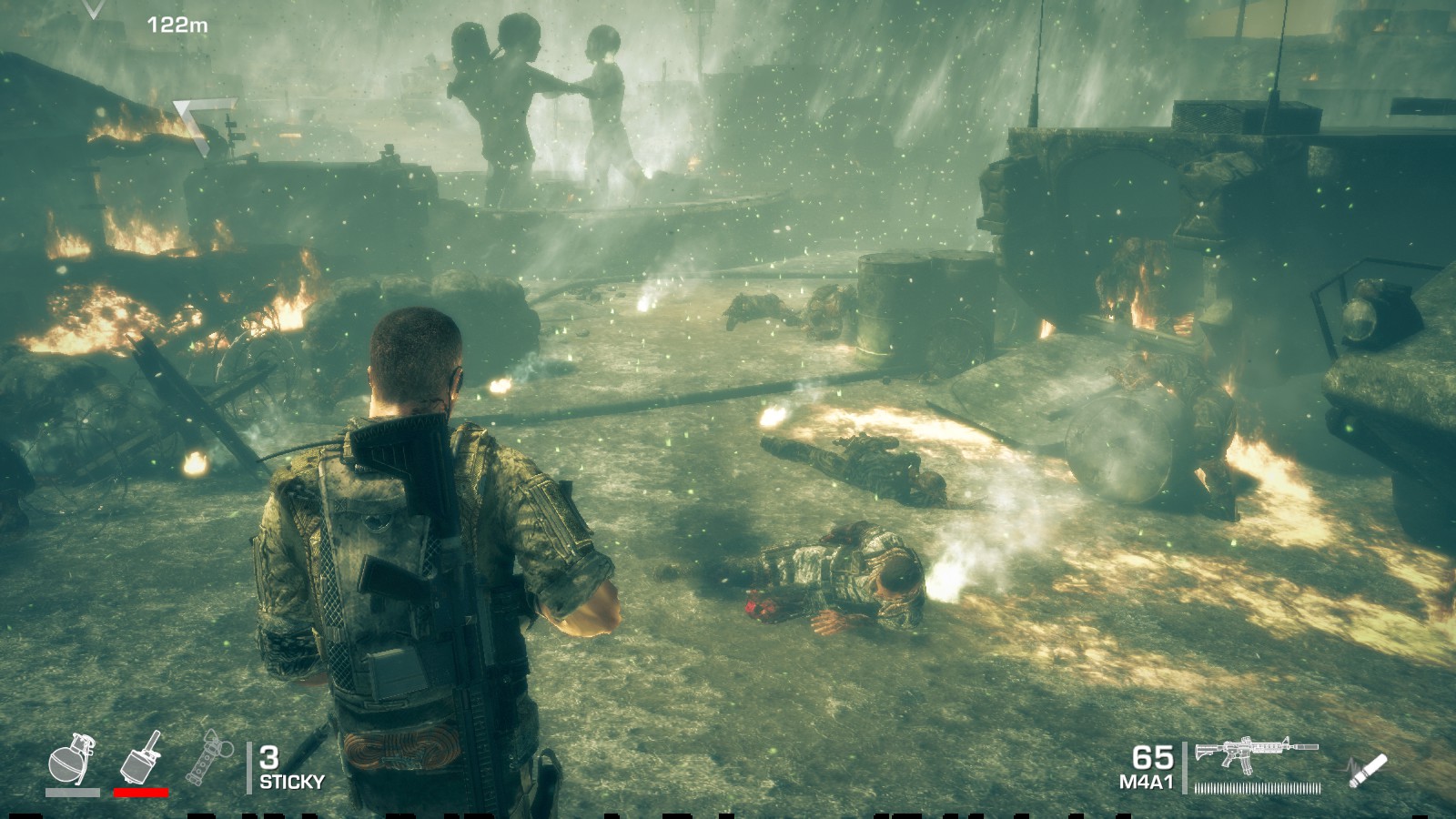
Spec Ops: The Line


In my opinion, the objective of art shouldn't be to simply entertain. That should be part of it, certainly... but there's a huge opening in there for so much more. That's a dangerous road to go down, of course. I mean, when a game says 'hey listen to my awesome philosophy' , then people take out the words didactic and shoot you down though.

When it's done well, you get Spec Ops: The Line, a game whose story is so stunningly good that it beats the everloving shit out of its recipient seamlessly without once appearing to be disingenuous or preachy.  It is a brilliantly conceived and beautifully executed indictment of the last ten years of war glorification and faux-heroism that our society has collectively indulged in.It isn't a game that's fun in the traditional sense. It hits you hard, but you come out the better end feeling all the better for it.

The narrative is exquisitely put together. It starts out simply enough... you are a Delta Force Soldier sent in with your two buddies to try to find people who survived a huge sandstorm that swept Dubai (something that apparently can happen there). An American distress signal is called and you go looking for it and run into some armed locals. The first hour or two of gameplay are really quite conventional. But then things rapidly change and the story goes to a much different place.

Spoilers from here on. Needless to say, I highly recommend it.

There are three elements of this thing that I'd like to underline...

1) White Phosphorous

This is probably the most talked about scene in the game. Walker has to break through enemy lines and finds a remotely targeted White Phosphorous artillery piece to shell them with. You are transferred to a birds-eye view camera angle where the enemy are little white pips on the ground. You then proceed to let her rip. At first I picked my targets carefully, but after a while I realized that there was no limit on ammo canisters and so I fucking carpeted absolutely everything with the stuff.

Two things happen then.

First you are shifted back to the realistic non-gamey graphics and are forced to walk through the devastation that you have wrought. And it is devastation.


Men are crying and screaming in agony. The disconnect between the feeling of raining death from the sky on little white blips and that moment cannot be larger. These are human lives that have just been snuffed out by your little technological marvel and there's no way even the most uncompromising soldier can just write it off (especially since they're damn American soldiers to begin with).


There's no glory in that victory. No honour.

Then you get to the end and see the true magnitude of your crimes.


Collotaral damage is what they call this, I do believe. Turns out a cluster of the white blips that your computer weapon was firing at was a bunch of innocents. Walker had no way of knowing that would happen, but then again who that ever uses a weapon like that ever really does? You've got your designated military target and you let loose until it's gone. And thankfully, none of the Drone pilots in Nevada even have to give that a second thought, since they don't walk through the aftermath when all is said and done.

But what really made the scene for me was what Walker did afterward... he denied it all. He claimed it was the enemy's own fault that this happened. That they'd brought it on themselves and that his hand had been forced. It's an excuse that is as hollow in the game as it is in reality, but it's the best he can do.

Goddamn.

2) Walker

From White Phosphorous on, it's a downward spiral for Walker. He's going insane and his decisions begin to be coloured by his bloodlust, cruelty and heroic fantasies. Subtle changes start to occur inside of him. At the beginning of the game, when you shoot a hostile American soldier down Walker will cry out "Tango Down!" or some other variety of military lingo.


 Slowly that starts to be replaced by "He's dead" and "And stay down!" The joy in his voice at each death he inflicts is audible. 

But more than that, Walker steadily begins to break under pressure. His orders steadily begin to amount to little more than casual and vicious savagery. When the crew escapes from renegade American soldiers in a helicopter, Walker tells them to circle around so that he can unload the minigun on his former pursuers. There's no reason for him to do this. They can't harm him anymore and it's just unnecessary and wanton destruction.


But he does it anyway. And the why of it is left appropriately unexplored. In an era where the architects of massacres get 0 years in prison, this is something worth reflecting upon.

But the defining moment came when your squadmate Lugo is captured by some Dubai locals. You try to reach him in time, but are too late... they've already hung him by the neck. I really liked Lugo. He was the wisecracker and he had the more human reactions to everything that happened. Losing him felt like loosing a friend.

After it's clear that he's dead, the mob closes around Walker. None of these guys have guns or anything. They're just people who are understandably upset about you shooting up their damn city  like a fucking maniac. I didn't want to hurt any of them. I just wanted to get the hell out of there.

But then someone threw a bottle or rock or something at me and set off the damage alarm. And so I immediately opened fire.


I emphasize the word 'I' there. That was my choice and my own self-preservation instincts. That's what's special about the game. Walker is a fucking insane murderer. But when push came to shove, I acted in just the same way that that cold and despicable mind did. I was Walker in that one moment, callously killing those that would kill me. An animal that exists only to preserve its own pathetic existence.

Goddamn.

3) War.

I can see why the game's writer chose to make the enemy in this game other Americans. Over the last ten years, shooters have gotten realistic in terms of graphics and gameplay, while still keeping the player neatly insulated from the actual feeling of taking another human being's life. Nothing like that in Spec Ops: The Line. Your enemies are basically guys just like Walker.


Have fun killing them!

But there's a definite political undertone here and I want to address it directly.

I protested the Iraq war back when the majority of people thought it was a good idea and to this day I don't think people truly realize why that misguided and vulgar conflict gave rise to so much tragedy. It happened because the Americans were not needed or wanted in that area of the world. It happened because of the eight scariest words in the whole world... "The American Army is coming to save you."

Walker is the embodiment of the Iraqi and Afghan War. He goes into Dubai for a combination of personal and humanitarian purposes and then stays there after things go wrong because he simply cannot stop. He cannot look at himself and say 'I've failed and have done far more harm than good', because then what is the meaning of any of it? Why did he kill all these people if not for some greater purpose? Surely one needs to get to an end that justifies at least some of these means.

But he never gets there and every fucking step he takes forward leads to more death and more misery. If he would just stop where he is and leave everyone alone, everything would be better. But he doesn't. A twisted sense of honour and martial pride lead him onwards, against any coherent reason.

For the last ten years, the world has stayed the course. We've beaten our heads against conflicts that have done far more harm than any good, while inventing new and creative ways to glorify soldiers while dehumanizing the enemy. And that is why Spec Ops: The Line is such an important piece of art. It is a rebuttal against all the fucking ugliness, self-delusion and lies of the last ten years. There is no glory here, no bad guy that you can put down to save the day. There's only the next pointless death, the next pathetic act of self-preservation and the next meaningless conflict.

Walker is us over the last ten years. And we do not look good.

Goddamn. 

Conclusion:

This is a necessary story that will hit just the right audience in just the right place. Glancing through the internet, one of the first comments I read about this game was that it was treasonous. I can think of no better endorsement of this game than that... because right now what the world needs is a little treason.

Treason against the man who killed 24 people in Haditha and walked free...
Treason against the helicopter pilot who gunned down 18 people in Baghdad...
Treason against the Siege of Fallujah...
Treason against the Drones...
Treason against the guy that shot 16 people, including 9 fucking kids, in Afghanistan...
Treason against the last ten years.

Yeah... sign me up for some treason.
There's more ...

Tuesday, June 12, 2012

Redshirts


So John Scalzi is probably the biggest name in science fiction literature nowadays, which as far as I'm concerned is kind of depressing.

On the Fantasy side you've got Patrick Rothfuss who, for all his faults, has the best writing technique and craft of our generation. There's also JK Rowling (who may admittedly have abandoned fantasy in favour of bullshit now) and solid fighters like Scott Lynch and Stephen Deas bringing up the rear. The last decade of fantasy has been extremely good and while most of the above authors aren't perfect they are nevertheless artists and they do produce quality work.

In the meanwhile, the best thing the science fiction scene has been able to produce is John Scalzi, a nerdy hipster capitalist who quite frankly seems to be willing to write just about anything that he thinks might make him a quick buck. A charlatan whose cold and empty stories reflect the cold emptiness of his soul.

So with my cards now thrown down on the table, let's talk about Redshirts.


All you need to really know about Redshirts' story is right there in the title. It's about the dudes on an Enterprise-like ship that die when they go on away missions or have their consoles explode when the ship is under attack and all that. The big twist is that they start to catch on to this phenomenon and start avoiding away missions and all sorts of wacky hijinks ensue.

So let's divide my discussion between what I think were Scalzi's goals in writing this

1) Humour

I actually went to see Scalzi read the first chapter of the book at a library. It's quite funny and self-referential and has an amusing meta-narrative going in there. If this had been a short story consisting only of the first chapter, I would probably have sent it around to friends and recommended it. Unfortunately however, there's an entire book that comes after that.

Redshirts essentially only has one real joke. That joke is: "Ha ha, Star Trek did some pretty cliche things." That joke is funny once, maybe twice. But an entire book that does not make. The other attempts at humour that the book attempts range from stupid cracks about blowjobs and stealing someone's pants. It's honestly quite pathetic. Clearly, whatever edge Scalzi had that made the Andorid's Dream as funny as it was has apparently completely drowned in a sea of internet memes.

When I went to see Scalzi's talk, he said at the time that this book was 'low-hanging fruit' and that no one had ever done this before. But the thing is that someone already had. And it's right here.

And that 23 second one-off scene easily has more humour value than Scalzi's entire book.

2) Parody

So this is a Star Trek parody, except that it's sort of not. The line in the book is that the ship is based on a fictional bad knock-off of Star Trek that was apparently really awful but still good enough to have six seasons (so it was at least better than Enterprise I guess). So basically what Scalzi does is construct a strawman and then makes a parody of that.

When I finished the book, I tried to think of instances where an ensign was killed in Star Trek by some random space animal (which is the most frequent cause of death for the red shirts). I remember when Garak murdered a good five ensigns cause of a drug. I remember when Sisko destroyed a planet. I remember when Picard and the alien captain fought a weird translucent alien on Tanagra, but there weren't any ensigns down there with him. Ensigns die in Star Trek of course, but I think you'd need to go back to the original to find deaths by random animals.

So why didn't he try to make an actual Star Trek parody? I see two possibilities. Number one is that Scalzi wanted to avoid being to referential and Trekkie (which opens the other question of why this book is called 'Redshirts'). Number two is that Scalzi doesn't really like Star Trek that much and didn't want to bother to do his research. And then I guess the third option is he thinks having people killed by random animals is somehow funny.

In either case, his decision to make a parody aimed at a fictional strawman is cowardly. He's having a go at Star Trek, but it's not really Star Trek so who can fault him? That's the kind of stance that shields him from someone going and pointing out that this scene from TNG is more sophisticated and well-crafted than everything Scalzi has produced in his entire career (a scene that hinges on the use of a minor ensign character incidentally).

3) Metanarrative

Being self-referential isn't a bad thing. Atonement proved that. But the problem is that this is done in such a snarky and self-congratulatory way that I wanted to find Scalzi and punch him in the head for being such a goddamn tosser. A large chunk of the book is just a 'bad writer' in the book writing a blog and realizing that plotting and character arcs are important. This is basically just John Scalzi standing on his soapbox and preach his shallow bullshit about writing. It's a complete drain to read and I literally started to skip pages when it kept going on and on.

But the main function of meta is to serve as an excuse. Everything about the way the plotline works out is melodramatic bullshit, but it's supposed to be like that because the author is trying to make it bad and is actually just highlighting the relationship between author and reader and all that nonsense. But look, that worked in Atonement because the basic story in Atonement is really good and the revelation that it's all just a puppet show for our foolish indulgence thus hits hard. In Redshirts the only reaction is 'Yeah, we know you're in on the joke, you've been making that abundantly clear for the entire book.'

And quite frankly the "It's supposed to be bad" excuse only goes so far.

The last 100 or so pages of the book are dedicated to Scalzi essentially trying to write Atonement. He wants to make a legit-seeming dramatic story so that he can pull a 'and it's all JUST A STORY' twist at the end. But the problem is that Scalzi just isn't capable of writing something like that. He can be passably humourous at times, but in not one of his stories in all 5 of the books of his that I've read now have I ever cared about even one of his characters. All the last 100 pages do is serve to highlight the fact that Scalzi is not an artist.

I hope that science fiction gets away from Scalzi soon, but my fear is that since Scalzi is the kingpin of science fiction literature nowadays, the genre is going to be defined more and more by the people who enjoy him, while the people that love Asimov, Adams, Simmons (before he went crazy), Westerfeld (before he sold out) and Banks (sometimes) are going to be pushed out. This will leave us with a small market that only craves the latest stupid metanarrative with Joss Whedonesque hipster characters (Note to authors: Those guys only work with actors, not on paper). And that is a damn grim future indeed. There's more ...

Friday, March 16, 2012

Mass Effect 3 - "So slow. So clumsy. Pathetic!"


I know that I never update this place anymore, but I figured I may as well revive it to talk about Mass Effect 3.

My review of the first Mass Effect was actually the first real post I ever made on this blog. Looking back at it, I was pretty unimpressed and to this day I stand by everything I wrote in there. Mass Effect's premise is completely derivative piece of science fiction with not a single decent original idea under its name. That was true then and it's still true now.

The question then becomes why I played two other entries in the series when I thought the first one was trash. The answer to that is two fold. For one, the gameplay got a major facelift in part 2. I could take cover behind blocks that no amount of futuristic weaponry could pierce and then shoot things. But the story also shifted in focus from rip-off world building to something more character based and thrived as a result.


Sure the world was still a rip off of various pieces of fiction, particularly 40k of all damn things. Like oh no, the colonists are being mind controlled and carted off into the scary bio-vessels. That's almost as bad as when the Genestealers did it. But even if the story wasn't super fantastic, at least I was enjoying it with characters I actually could like and I could at least feel as though my decisions as the Shep was affecting the outcome. I didn't like it so much that I played through it twice the way other people did, but it was still good.

And so it was that I found myself getting genuinely excited when the third one started to roll around. I would get to hang around Garrus, Tali and Mordin again and cart around the ridiculous Mary Sue known as Commander Sheperd so that I could save the galaxy from the Necrons.


And so it was that I could set out to save Earth again, smiling indulgently as the game melodramatically focused in on some little white boy getting killed and then told me to start building the Ultimate Macguffin. I got to imitate Picard as I saved a barbaric race from extinction and I got to rehash that one episode of TNG when I declared that robots have souls. I fought against an assassin who was Asian and therefore decided that using a sword in a science fiction setting centered mainly around guns was the way to go.

And you know, it was good. Sure the world around me and the story that was unfolding was still this ridiculous hack melodrama, but I could at least kick back and hear Garrus deliver lines about how I'm the damn best soldier ever or have Tali tell me she loved me as I went to kill a Reaper with a laser pointer. And I liked being able to pick dialogue options and watch Shep say and do cool things, because it let me believe that I was actually that eloquent and heroic.

The story was ultimately just a mishmash of other things, but even if I'd seen it all before it was all in such a nice and pretty package of top-notch voice acting, strong characters and fun run-and-gun gameplay. And so I enjoyed it. Hell, I frickin' loved it.

But then at the end of the game, I think Bioware made the biggest mistake that it could ever make: They had an original idea.

A series so heavily rooted in cliche like Mass Effect needed a cliche ending. You know what I'm talking about... the kiss followed by the walk off into the sunset. Or even a 'you become Emperor of the Universe' type deal. Anything of that nature. But Bioware, so inflated with their fan's praise, somehow decided that they were artists here. That they weren't just people that put stuff that other, better, authors and artists have done into a shiny package.

And so, at the last minute, they took a stab at originality.

The result was a pseudo-philosophical abomination that has soured the entire franchise like nothing else ever could. An ending so rancid that it has provoked spontaneous charity drives to protest it and shook the very internet to its core.

I don't think I need to talk about it at length. Lord knows that you can find commentary aplenty on it elsewhere. If Bioware has committed one sin, it's this:

Hubris.
There's more ...

Saturday, March 5, 2011

The Wise Man's Fear - The cut-flower silence of a man waiting to die


Go read this book. Right now.

Done? Okay. Let's talk.

So Pat Rothfuss is quite the guy.

He's got a way with words. The sheer amount of skill that comes out in his phrasing, sentence structure and paragraph length is just breathtaking. Rothfuss is poetic without being overwrought. He's clever without being silly. He can describe a song so well that you can hear it and magic so well that it feels like you could try doing it yourself.

His characters are well measured and structured. With a sentence here or a word there he can convey a character trait that would take a lesser author a good 10 pages to convey. And more importantly, they feel like real people. Whenever Rothfuss strays near an archetype (i.e. mean old noble guy) he'll salt something in to differentiate them. Screentime is carefully managed to leave the reader with the correct impression of a character.

I have been of the opinion for some time that Rothfuss is in fact the best author currently making use of the English language. We are privileged to live in his generation. While I was reading this book I did little else. When I walked down the street, I had my Kindle in hand reading. When my Associate turned his back, I would pick up my Kindle and read. I've been reading the book at every opportunity for the last 4 days.

Having finished it now, I am in awe of Rothfuss' skills and wonder how it is that a man of such incredible powers could make so many mistakes.

There are three ways in which the Wise Man's Fear disappoints. Let me emphasize again before I begin that this is still the best book written between the release of the Name of the Wind and now.

SPOILERS AHEAD


Flaw #1 - Plot

I really think what Rothfuss did right in the Name of the Wind was to take a step away from the World Building style of fantasy that plagues the genre these days, choosing instead to leave most of that stuff aside so that he could run a tight-plot. Even as Kvothe mucked about in the University and fought a Draccus, the plot never loses sight of the Chandrian

The Wise Man's Fear, on the other hand, does just that.

Going on a trip to Vintas to visit some Lord guy? Cool, that broadens the setting.

Fighting some bandits? Well okay, I guess that's how everybody gets their start.

Having sex with one of those slutty Great Faeries from Zelda? Oka-... wait, what?

All of the encounters are linked back to the main story just so clumsily. Kvothe getting information from the head karate lady in the one town just felt video game-ish, with Kvothe asking for what essentially amounted to a Quest Reward.

And honestly, where did the main plot really even go in this? Besides a brief Cinder cameo with the bandits and a few repetitive rumours (I know there are fucking seven of them and they don't like the Atur, let's move on), the Wise Man's Fear offers next to no new information. There's a list of names sure and you get how they knew someone was singing about them, but there's no more information about what their problem is. Honestly, I've waited for this for years and this is all I get? Surely some of the information coming in the third book could have been moved up into two.

Flaw #2 - Pacing and Kvothe's powers

A lot of the things in the book easily overstayed their welcome. Kvothe's training with the Adem is the first thing that springs to mind in this list. That was just pure World Building Fantasy. Chapter after chapter doing little more than exploring the eccentricities of these weird Karate People's culture. I don't understand the reason why that had to last as long as it did. I mean, maybe if the whole Lethani thing were linked a bit more closely to finding the Name of the Wind it would have been a bit better, but the whole thing seemed pretty arbitrary.

I also think that on one level Kvothe is getting a bit silly. In the Name of the Wind Kvothe was an eternal underdog, but now he's a Rich Magic Karate Singing Sword Man (who's great in bed). I know it's all going to fall apart nonetheless and sink him into a shitty inn in the middle of a bunch of shit farms. But did he really even need to learn all that martial arts shit? Personally I think sticking with goddamn magic would have been a lot better. That stuff he did when he used sympathy on a corpse to slit those bandits' throats was fucking awesome. I'd much rather he do shit like that then go around using obscure Karate.

I did really like the poem about beating up the 10 year old girl though.

And it was a bit of an odd choice to make the Karate moves and the sex moves have such similar names. "Thousand Hands" vs. "Sleeping Bear", etc.

Flaw #3 - Women

Okay. Let's start with the more minor problem...

So I remember Rothfuss once describing himself as a casual anime fan, but... well, I don't think that's true and that he's minimizing that. Because the first chunk of the book in the University really did read a lot like a harem anime. An Event here with Devi (Tsundere-type), another one there with Mola (Senpai-type), another with Fela (Idol-type) and another one there with Auri (Mysterious-type). Like a harem, none of these things were allowed to come to a natural conclusion. Kvothe would have a meaningful scene with one of them and you'd think 'oh okay how is this going to develop?' only to have him a similar scene with a different girl in the next chapter.

Pure harem. That isn't a major crime in and of itself, but it certainly was an odd choice.

But then there was Felurian.

I think I was hoping for a more Jonathan Strange/Mr. Norrel path into the fae lands, but I can get over that. If I could describe the way those chapters were written as anything it would probably be self-indulgent. His decision was his decision. It was certainly interesting to see Rothfuss amazing powers of writing employed in something so raunchy.

But what I don't like is what it did to Kvothe's character. Whenever Kvothe meets a pretty girl I must now ask the question 'Is he going to sleep with this lady?' On average, the answer in the WMF after the whole Felurian thing appeared to be 'yes' (unless she was underaged, which is a small mercy). Rothfuss in this regard seemed to be expressing a sort of promiscuous philosophy at times so I was glad when Kvothe's dalliances resulted in him being shut down with Denna. At least that shows that Rothfuss is aware of the limitations of that philosophy, but I nevertheless don't think that Kvothe being a man-slut serves his character very much.

Also I really don't like Denna. And her patron is almost certainly a goddamn Chandrian.

Nevertheless...

This was a fantastic book. Brilliantly written, well-structured and well-executed. I am eager to see how the plot will develop and look forward to having some friends read it already so that we can discuss questions as to Chandrian identities and where the heck Skarpi or Bast are or how Kvothe should just forget about that Denna bitch and focus his attentions on Auri.

There's more ...